|
Send E-mail |
Unfortunately the VC10's career was not without its darker days. Two crashes claimed lives and several other airframes fell victim to terrorism, fortunately without loss of life. Other incidents that have occurred during the VC10's career are also included here to illustrate the fact that the VC10 also saved lives because of its well thought-out safety features and sound structure. Accidents (hull-loss events): Other incidents: 9G-ABP Beirut 28 December 1968
Remarks: Information from Aviation Safety Net The December 1968 raid on Beirut Airport was codenamed operation 'Gift'. In July of that year an El Al airliner had been hijacked and forced to land in Algiers. In November another El Al airliner, about to take off from Athens, was fired upon by two terrorists, causing the death of one Israeli passenger and leaving a stewardess wounded. Within weeks the Israeli Defence Force set up and carried out a commando raid on Beirut Airport with the intent to destroy as many Arab-owned airliners as possible. Originally timed for 22:00 hours, the timing was brought forward by 45 minutes to catch as many aircraft on the ground as possible. Some sources say that the changed timing was to make sure that a brand new MEA 707 would also be included in the raid. The first Super Frelon helicopter touched down at 21:18, delivering the first of three groups of 20-22 commandos. The other two groups were delivered to their areas of operation, split into an East, West and Terminal area, only minutes later. Once on the ground the commandos quickly made their way past the various parked airliners, evacuating them before placing explosive charges on the nose gear and one main gear. An ex-BOAC radio operator remembers that they were just recounting the passengers in their MEA 707, having discovered an extra passenger, when an Israeli commando turned up at the top of the air-stairs and announced that they had four and a half minutes to evacuate. This was achieved, but with the cockpit crew using the escape ropes through the cockpit windows. From the terminal building they observed the various airliners bursting into flames outside. In total, fourteen airliners were destroyed in a raid that lasted only 45 minutes. Trans-Mediterranean Airways lost a DC-4 and a DC-6, Lebanese International Airways lost 2 DC-7s and 2 Convair 990 Coronados, causing them to go bankrupt within weeks. Middle East Airways lost 3 Comet 4Cs, 2 Caravelles, 1 Vickers Viscount, 1 Boeing 707-320C and their single, leased, VC10 that was owned by Ghana Airways. There were no human casualties.
Remarks: Information from Aviation Safety Net The Long Story The investigation into the accident was hampered by the fact that all the facts had to be deduced from the clues at the crash site. The aircraft was fitted with an Epsylon Flight Data Acquisition System (EFDAS) flight recorder which was found undamaged. After transport to the United Kingdom for readout it was found that the data consisted only of a stream of alternating ones and zeros. Apparently there had been a fault in one of the logic units of the system, something which could not be detected from the flight deck. No readable data could be reconstructed from this. Taped ATC conversations at Lagos turned out to be almost unreadable due to problems with the recording equipment and a period of 44 minutes, covering the descent from FL350 down to FL140 and the subsequent events up to and including the crash, had not been recorded as the tapes had not been fitted correctly. Careful transcription allowed most of the conversations to be recovered from the available tapes. The position of two valves in the airconditioning system allowed the investigators to conclude that the flight engineer had just started his landing checks when the aircraft crashed. This pointed towards a normal flight deck situation with the crew unaware of the incorrect altitude of the aircraft. If anything would have been amiss then the flight engineer would most likely not have been carrying out his routine tasks. Several tests were carried out by Vickers/BAC at the request of the investigators, using calculations, flight test results and the company's variable stability simulator. Possible scenarios included an inadvertant operation of the stall identification and stick pusher system as well as several descent profiles with and without abrupt nose-down elevator applications. There were only two profiles which produced the attitude and descent parameters which matched the crash scene. The first was a steady descent at flight idle and 160 knots, the second an application of full nose down elevator around 300 to 400 feet AGL and partial recovery. As this last scenario was extremely unlikely to have occurred, the conclusion of the report was that the Commander had elected to descend below the sector safe altitude of 2000 feet, probably to establish visual contact with the ground as soon as possible, and allowed the aircraft to come below the obstacle clearance limit of 532 feet without visual reference to the ground. Click here to read the full report of the accident investigation. On this final flight, the aircraft was crewed by Captain Val Moore, First Officer John Wallis, Engineer Bert Baker and Navigator Basil Payton. Many of the 87 victims of the crash were buried in a communal grave in Atan Cemetary, Lagos,Nigeria. To read more about how this event influenced the families of the crew members, click here to go to the Memories section.
Epilogue "As a recent graduate going out to join an oil exploration team in Nigeria, we (three new graduates, working for the same company) were booked on Nigeria Airways to Lagos on 19 November 1969. When we arrived in London our company representative advised us that there was a delay in processing the visa by the Nigerian High Commission. Because of this we missed the flight, and stayed overnight near London. The following morning we were told of the crash at Lagos. We were all in something of a state of shock at the time! I travelled to Lagos on the BOAC flight on the 20th, presenting my tickets for the previous day's flight much to the consternation of the BOAC check-in staff." G-ASGN 'Dawsons Field' Jordan 12 September 1970
The end of G-ASGN
after being blown up by terrorists
Remarks: Information from Aviation Safety Net More about this on the Hijackings page. G-ARTA London Gatwick 28 January 1972
Remarks: Information from Aviation Safety Net A detailed account of the final flight of G-ARTA can be found at the British Caledonian tribute website through this link. 5X-UVA Addis Ababa 18 April 1972
5X-UVA seen at
Paris Orly Airport on 7 June 1969.
Remarks: Information from Aviation Safety Net The Long Story 5X-UVA was the first VC10 out of the five ordered to be delivered to East African Airways. At the time of the accident the aircraft had accumulated 18586 hours with the joint Kenyan, Tanzanian and Ugandan airline, flying between East and Central Africa, Europe and Asia. Earlier in April 1972 problems with the brakes on the left-hand main gear had resulted in several component changes, unfortunately there were no functional checks of the system after these component changes which would have shown that one of the anti-skid units had a seal fitted that didn't belong in the assembly and which was blocking several ports rendering the unit useless. Two days after this the left-hand rear tire burst during a landing roll and as the anti-skid unit was deemed the culprit this was changed, again no functional check was performed. This would have shown that the two anti-skid units serving the rear wheels on the main gear were cross connected, another result of the earlier component change. The faulty anti-skid unit was therefore still in place on the main gear. The Haile Selassie 1st International Airport sported a single runway in the direction 07-25. In the months preceding the accident this runway had been resurfaced with asphalt and also lengthened to 3700 meters. To enable the runway extension the ground level at each end of the runway had to be raised, at the far end of runway 07 this resulted in a 10,6 meter drop at the end of the stopway. To get the approach lighting up to the runway level a steel lattice tower was constructed 24 meters past the end of the runway, with other towers supporting the rest of the lighting system. All this work was finished by 7 April and announced in a NOTAM issued on that day but this bulletin made no mention of any revised runway length. The last grain of sand that would find itself in the works that day was one of the 37 aircraft movements that morning. A locally based Cessna 185 took off with an improperly stowed jacking pad. During the take-off roll this rectangular piece of steel got left behind on the runway surface. From that point on all the ingredients for a serious accident were in place. The crew for flight EC-720 (Addis Ababa - Rome - London) had prepared for the take-off by performing the normal performance calculations, as no new figure was available for the runway length they chose to allow for half the runway extension, thereby making use of it but staying on the safe side as well. During refuelling the Flight Engineer was inspecting a small hydraulic leak on the left-hand main gear. As the leak was within acceptable margins the decision was made to continue the flight and have the leak fixed in London. After start-up the aircraft taxied to the runway, while back-tracking to the take-off point they asked the tower to have several dead birds removed from the runway. This was performed by a fire truck, after they vacated the runway the take-off clearance is given at 9:38 (GMT), one minute later the aircraft is rolling. Just after using half the runway length the jacking pad punctures the right-hand nose wheel causing the tire to burst. The crew felt a severe vibration and according to the flight engineer they experienced a 'loss of control'. The decision to abort the take-off is made just as the nose starts to rise, it comes down again immediately and the engines are throttled back and selected to full reverse. A few seconds later, with the aircraft braking hard, a second bang is heard as the no. 1 rear main tire on the left-hand side bursts because of the non-functioning anti-skid unit. With one tire and associated brake unit out of action the other seven wheels would now have to stop the aircraft in time. Unfortunately there were more problems with the brakes causing no.2 and no.4 brakes on the left-hand side to malfunction, altogether only 70% of the maximum certified braking energy was available and this meant that the aircraft was still traveling at over 60 knots as it left the end of the runway and became briefly airborne before dropping onto the sloping ground 10 meters below. This and the wing hitting the steel approach lighting tower caused the aircraft to break up and with a major fuel tank ruptured fire quickly broke out. With the aircraft broken in three large sections many passengers and crew are able to evacuate the wreckage but this is hindered by jammed doors on one side and fire on the other side. Unfortunately 43 persons die in the flames, 15 are injured. The examination of this accident concludes that the decision to abandon the take-off was made in time and was properly executed with enough runway remaining to stop the aircraft. The faults in the braking system caused one tire to burst and provided only 70% of the maximum braking effort, causing the aircraft to overrun the end of the runway. There are many influences that led to this accident and with any one of them not in place the outcome may have been a lot different. However on this day it caused 43 deaths. To read the official report click here. Harriet Ware-Austin lost her two sisters on this tragic day, she has shared her memories, combined with her mother's account, on this page. A RAF crew carried the survivors and their family back home on XR808, an account of this can be found here: VC10 Crash. Ethiopia, 1972. (archived version) British Pathe has some footage showing the aftermath, with firemen and other workers going through the still smouldering wreckage. It must have been part of a news item at the time but it's quite graphic in a sense and can be upsetting for some (click here if you do want to watch this). G-ASGO Amsterdam Schiphol 3 March 1974
Remarks: For more about this remaining piece of fuselage (including photos) have a look at the 'Bits & Pieces' page. Information from Aviation Safety Net Mr. Tony Johnson e-mailed me and provided some information relating to this incident: "Your article on the fate of G-ASGO at AMS prompted me to check my logbook – I was third pilot on G-ARVH, having been called from standby, on 4 March 1974 and operated to AMS to collect the passengers from 'GO. As we taxied in we saw 'GO being towed on a parallel taxiway – a very sorry sight. During passenger boarding the flight engineer (Phil Newman) saw the passenger baggage being loaded and came onto the flight deck with great concern. The Captain (Dave “Dinger” Bell) and I went to investigate and found that each passenger bag had been placed in a large clear plastic bag along with many litres of water that had entered the baggage when the Schiphol fire services extinguished the fire on 'GO. This presented the problem of unexpected additional weight of the water. It was impractical to empty each plastic bag (it would have taken too long) so the loadsheet was altered to account for the estimated amount of water on board. The return flight to LHR was uneventful." As the incident happened not too far from where I live I went and looked up some information in the local newspaper archives. From these articles I've pieced together the following story. This story has been moved to the Hijackings page. XR806 Brize Norton 18 December 1997
Remarks: Information from Aviation Safety Net I received this comment from
Mike
Howles: The demise of XR806 is also the subject of an e-mail from another visitor: The aircraft had a problem with the fin tank indicator on the Flight Engineer's panel and it continually showed 0. The engineer tasked to defuel the aircraft, an odious task, elected to perform this from the Flight Engineers panel. He removed all the fuel from the wing tanks, the fin tank showing empty was ignored. She also had wing refueling pods fitted which move the center of gravity rearward and no counter weights in the cabin to counter it, as a result she gently sat on her tail." As it turns out not all of XR806 was scrapped in 1999 because the forward fuselage has been used for battle damage repair training between 1999 and 2009. For more details have a look at this page: G-ARTA elevator flutter during testing - 31 December 1963 To use Brian Trubshaw's words: "The last day of 1963 nearly brought the stalling programme to an abrupt end". By that time G-ARTA was engaged in tests to validate the stick pusher which was needed to conform to the ARB's demands with regards to the stall of the VC10. While recovering from a clean stall and accellerating through 250 knots the airplane started shaking violently. The senior observer, Chris Mullen, had been looking at the tailplane through the periscope throughout the excersise and shouted 'Right inner elevator'. The airframe was shaking so much that Trubshaw gave the order to bail out and fired the bolts that held the forward escape hatch door on. This hatch was mounted in the forward freight door and a chute was provided to lead from the main deck, through the forward hold and extend below the aircraft to allow the crew to escape safely. Unfortunately this chute had collapsed under the strain of the airflow and only a 'jangled bunch of metal' remained so it was good that nobody tried to use it. They were unable to as the crew on the flight deck, Flight Engineer Roy Mole and Co-Pilot Peter Cane, were unable to get out of their seats, while the crew in the back never heard the order over all the noise that was going on. Trubshaw managed to reduce the speed to about 160 knots and the violent vibrations and oscillations calmed down to a reasonable amount. This enabled him to coax the aircraft back to Wisley, having announced a Mayday situation to ATC. As half of the aircraft services were lost the right main landing gear had to be extended using the free fall system mounted in the avionics bay, but a safe landing was made at Wisley. Subsequent inspections revealed that the right inner elevator had a broken attachment bracket, which had caused that surface to flutter. This had caused such vibrations throughout the airframe that two fin attachment bolts were severed and the two right hand engines were rotated two inches in the nacelles as their thrust mounts had fractured. The aircraft was obviously grounded for repairs but flew again in February of that year. BUA's Freddie Laker (later Sir Freddie) called Brian Trubshaw the next day to check on his good friend, but also to ask 'how much will that one be going for now?' For an interesting sidenote about the VC10's escape possibilities have a look at this memory from John Cannell. Ex-Vickers Ground Crew member Maurice Ungless sent me the following notes about this incident: "I would like to make comment with regard to Brian Trubshaw's account in his autobiography of the incident with G-ARTA when the aircraft was very nearly lost. Far be it for me to contradict the great man Brian Trubshaw, and he is no longer around to back that version up, but I have one issue with his description some 35 years after the event at the time of his autobiography. With all due respect to him he was in a dire situation and maybe some of the event got muddled. I remember the event well, although not being on G-ARTA at the time of the incident. Ground crew were not allowed to fly on any aircraft that was going to be subject to stall trials. I was on another VC10, probably Victor Bravo, returning from trials at Boscombe Down, landing about half an hour after G-ARTA. On our taxi in someone looked out a cabin window and commented, "there’s something wrong with that VC10, there’s an elevator section fully down". All flying control panels with their PCU switched off are at near to neutral unless switched off with an input applied. On exiting our aircraft we wandered over curious and were told of the events to G-ARTA. By then all crew members had been transported to hospital, some with bleeding ears because of the sudden decompression when the escape door was jettisoned. The two engines had indeed moved and it was lucky an aborted landing hadn’t been needed. Had that been the case the aircraft would have undoubtably crashed. Both engine's thrust bearing brackets had completely fractured and any attempt to increase to any appreciable power would have had the engines exiting out the intake cowlings. They were only attached to the aircraft by the four engine hanger links, (which aren’t designed to absorb thrust, only the weight of the engine), and the cables and pipes of the various services.
My issue though is with the description of events of identifying the cause of what was a "porpoising manoeuver" of the aircraft. His version was that a flight observer had looked through his periscope. The only periscope he could possibly have looked through would be either of the two rear periscopes to see the tailplane. These were never left in position and would have had to be removed from their stowage and fitted, and which one, luck or what. There was also no flight observers position at the very back. I’m not sure whether extra periscopes were fitted to a window blank at anyone of the observers positions in mid cabin, but if there were, nobody would have been able to put an eye to them with the violent manoeuvres being applied to the aircraft. The aircraft was in this condition for a matter of something like 20 seconds from memory. (It was calculated later that, had it been in that condition for another 5 to 10 seconds the aircraft would have broken up). Nobody would have been able to walk to or hold their eye to a periscope or hold steady that periscope in the condition they were in. The information I received on the day, was that on the initial failure, Brian Trubshaw firstly fired the escape chute mechanism, then looked up to his "small aeroplane" as we called it. This was a small indicator panel measuring about 10 inches by 5 inches, above and between the two pilots on the overhead panel. It had indicators for every individual flying control surface panel. The indications were driven by desyne transmitters from each individual surface, four elevator, three rudder, four aileron, and six spoiler/airbrake panels. Brian Trubshaw looked up and saw the inner right elevator panel moving full movement either way, he shouted to the flight engineer "right inner elevator switch off". The flight engineer apparently was unable to reach the switches immediately, as the violence of movement was such he couldn’t raise his arms without them coming down again. (Ever been on a fairground ride, try putting your hands up in the air when the vehicle you are in is going up). Eventually he managed to claw his fingers up the panel to turn off the subject PCU and the "porpoising" stopped. Also in Brian Trubshaws account, he indicated it was elevator "Flutter"..Sorry this was not elevator "Flutter", "Flutter is a consequence of an unbalanced control surface and is quite small fast variations in angular movement and results in a resonance build up that can eventually break up a structure. No, this was the consequence of the failure of the PCU bracket's attachment to the trailing edge member of the tail plane. Further investigation found that one or two of the four bolts attaching the bracket to the trailing edge member of the tailplane had not been torque tightened sufficiently causing undue stress to the bracket flanges and eventually failure of the bracket. With the bracket broken the PCU was free to float around within the confines of the trailing edge and elevator, such that spuriose inputs were input into the PCU control valve. With the PCU extension and elevator deflection one way, an input was created in the opposite direction, and so it continued on full deflection one way then the opposite, causing the aircraft to "porpoise" violently until it was switched off, it then went into trail mode as there was no attachment of the PCU to the trailing edge. Hence when it was on the ground the surface just went full deflection down. In fact in later years at British Airways when I became a Licenced Aircraft Engineer the CAA licencing authority within the terms of the licence holders administration, issued Alerts & Updates for incidents applicable to aircraft under the CAA register. Some articles were deleted now and again and others raised. However when I retired 10 years ago there was still in that folder of Alerts the incident with regard to the importance of torque loading of bolts, refering to the incident of G-ARTA, but not by actual aircraft name or registration even though it occured 40 years before. G-ARTA was indeed mortally wounded. The wing had several leaks, the two engine thrust mounts were fractured with additional damage to the surrounding nacelle structure. Looking down the cabin, the hat rack rails were like a fairground ride. Tailplane bolts and brackets were also broken. It took several weeks to repair before it flew again, but fly it did." According to an online encyclopedia flutter is 'a self-feeding and potentially destructive vibration where aerodynamic forces on an object couple with a structure's natural mode of vibration to produce rapid periodic motion.'. The description by Brian Trubshaw and the comments from Maurice Ungless show that there are more ways than one to look at such an event. Trubshaw may not have looked beyond his experience as a test pilot and therefore stayed with flutter as a cause. Maurice Ungless, as a technician, went a step further and looked at the underlying technical reasons for the movement of the elevator panel. Based on his comments it appears that it was not purely an aerodynamic phenomenon but more a coupling between the aerodynamic forces and the PCU movement which caused the violent shaking of the airframe. Hit play to go to 20:27 in this 1969 documentary about Brian Trubshaw, where he and Roy Mole describe the flutter incident on G-ARTA. G-ARVK door opens in flight - 20 June 1965 On this day Standard VC10 G-ARVK was flown in support of its C-of-A renewal, the first to be carried out on a Standard VC10. Chief Pilot for the ARB, D.P. Davies of 'Handling the Big Jets' fame, was on board to oversee this event. During the flight over the Bristol Channel climbs and descents were carried out and the warning lights for the rear passenger and galley doors illuminated. This was something that had been experienced before during unpressurised flight. A visual inspection showed the rear passenger door to be 1/4 inch from its closed position (it needs to be moved up by 2 inch to open). While depressurising the cabin and descending through 12,000 ft to a lower level to re-seat the door, a heavy "thump" was felt along with a pressure wave through the aircraft. The door had left the aircraft, damaging a wing fence and the no.1 engine nacelle on the lefthand side as it did so, and fell in the sea. Nobody was near the door when this happened. No.1 engine was shut down as a precaution and G-ARVK returned to Heathrow minus one door. As a result of this incident it was decided that the door's anti-g lock, which was found not to be correctly in position, should also be visually checked. All VC10 aircraft were therefore modified with inspection windows in the door trim so that this automatic lock can be inspected for proper engagement. Sources: Aviation-Safety.net
5Y-ADA Fuel starvation incident - 30 May 1967
On this day 5Y-ADA was scheduled to fly the Bombay to Nairobi route. The crew had enjoyed their rest days in Bombay but on the day of departure the Flight Engineer reported to Captain Peter Brumby that he was feeling unwell, most likely from food poisoning, a not uncommon ailment on the Eastern routes. Brumby did not like to delay their departure and convinced the FE that he would be better off flying home and that he would keep an eye on things. And so the crew left for the airport on time, on what was a night filled with tropical storms complete with thunder and lightning. With a lot of the passengers asleep before take off the aircraft was quiet as it climbed through 10,000 feet on the first leg to Karachi. The FE suddenly got violent dysentery cramps and told the Captain he was leaving his panel safe while he went to visit the toilet. This meant that the fuel booster pumps would have been switched on to cope with the engines' climb power demands above about 20,000 feet. Around 15,000 feet a horn sounded and the crew noticed that the power of all the engines had decreased very quickly. Unable to maintain height the autopilot pitched the nose down to maintain the airspeed. All four engines had stopped but one generator remained on line. Prompted by a shout from the captain, purser Harry Everitt rushed to the toilet and hammered on the door for the FE to return to the flight deck. By the time he reached his seat the aircraft was descending rapidly towards the Indian Ocean. One by one he restarted the four engines and as power was restored the descent was arrested and the aircraft resumed a climb towards its cruise altitude. There was one passenger who had noticed the engines stop and would not accept the standard story that it was 'a minor technical hitch'. He demanded a large scotch, 'on the house'. From Karachi the aircraft continued on to Nairobi and after arrival they crew explained that they had run into icing conditions which had flamed out all four engines. This was something that had not happened before and questions were asked why the aircraft had not been grounded at Karachi for checks. The crew stuck to their story but soon telexes came in from BOAC, BAC and Rolls-Royce asking for information. EAA conducted their own test flights with booster pumps switched off on one engine up to 30,000 feet. The engine flamed out at 26,000 feet but the flight recorder showed that on ADA the engines had quit around 15,000 feet. The crew was interviewed extensively about the event. Rolls-Royce set up a Conway on their test-bed under simulated heavy icing conditions and ran it until it exploded on the bed, causing thousands of pounds worth of damage. Later they copied the EAA test flights with a chartered BUA VC10 from Gatwick, obtaining the same results. In the end their 100-page report stated near the end that 'The Captain was a most unreliable witness to the events that happened'. This may have been in response to their inability to reach a clear conclusion. A year or so later Chief Training Flight Engineer Tim Nightingale figured out what could have happened. What if the FE had mistakenly switched the cross-feeds OPEN instead of the fuel booster pumps ON during his pre take-off checks? This would not have posed a problem during the take-off. When the FE left his station he then switched ON the booster pumps and as the aircraft had been at Bombay for several hours during the hot and humid monsoon season, this could have pumped several gallons of water from the bottom of the tanks through the cross-feeds to the engines. If the crew had not carried out a full fuel drain check before departure then this could well have been the true sequence of events. G-ARVB ice encounter - 2 February 1968
While flying over the Persian Gulf on its way to the UK, Standard VC10 G-ARVB ran into a violent storm between 5000 and 10000 feet which contained hailstones of very large size. The damage that was done to the airliner was severe, apart from dents in all the leading edges the radome covering the radar antenna of the aircraft separated from the fuselage, hitting the top of the tail. The resulting blunt front end of the aircraft created strange airflows around the nose section, rendering the pitot tubes which are mounted just behind the cockpit on the fuselage sides completely useless. Normally the airflow into these tubes provides the airspeed information, but in this case the airspeed indicators were useless. Obviously Captain Chris Ditmus radioed for assistance. To get the airliner down safely a 208 Sqn. Hunter from Muharraq was scrambled to escort the BOAC aircraft. Piloted by Flt. Lt. Ray Tyler it flew alongside the airliner, providing airspeed information over the radio, and thus enabling the VC10 to make a safe landing at Bahrain. It wasn't the end of the excitement for that day though, as the Hunter suffered a full hydraulic failure, after a second full emergency call-out the Hunter landed safely as well. Here is what some publications had to say about the incident: National newspaper: "Aircraft Damaged By “Tennis-Ball” Hailstones. A V.C.10 airliner arrived safely yesterday after being hammered by
hailstones the size of cricket balls while it was taking off from Bahrein
Airport. RAF News, 24th February 1968: "Hunter in VC 10 Gulf drama In a drama over the Persian Gulf a Hunter took over the guidance of a BOAC
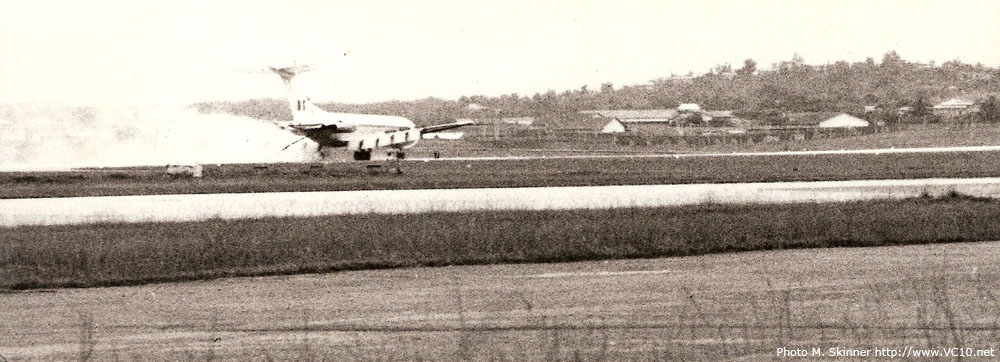
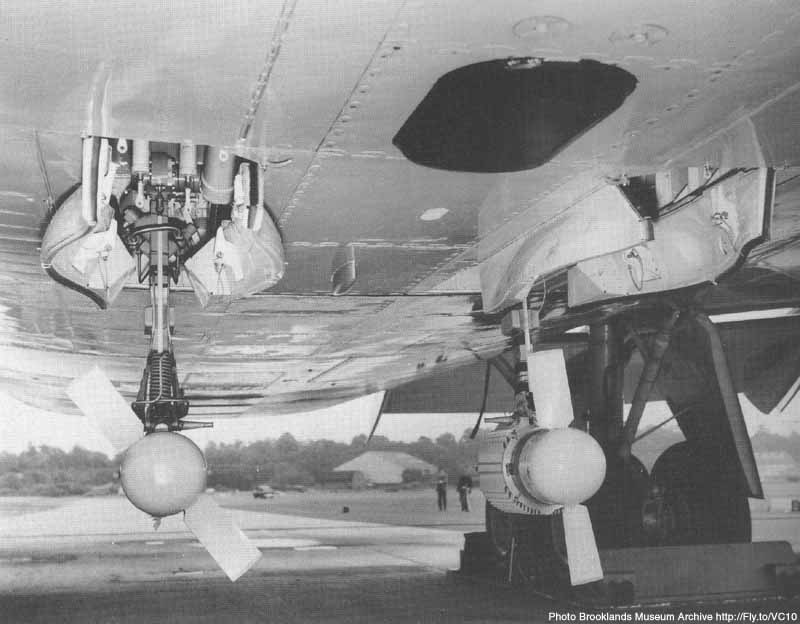
VC 10 to safely land its passengers in Bahrain. And the last word is for this unknown (but probably local RAF-) publication: "And by the way, let’s not forget the RAF Hunter pilot of 208 Squadron, Flight Lieutenant Ray Tyler, down there in Bahrain, who having nobly sprung to the help of Chris and his blokes, and seen them safely down on the ground, promptly found himself right up to the ears in the John Innes No. 1 when he lost all his hydraulics, including his TPI. We’ve heard that a Hunter’s practically unflyable without its TPI, but this boyo managed to get back in. We only hope that somebody saw to it that he was liberally dowsed in John Thuillier champagne." (TPI = Tail Plane Incidence or tail trim) Actually that wasn't the last word about this incident, as ex-VC10 Flight Engineer N. Boulton contacted me with his memories of this incident. So read on! "I had operated the Bahrain-Delhi-Bahrain shuttle with G-ARVB (Captain Whittaker) and handed over the aircraft to Captain Chris Ditmus in Bahrain. Our crew were back in the Bahrain BOAC Resthouse having a beer (There were no hotels in Bahrain at that time - The Gulf Hotel was unfinished), when we got a phone call for the Captain and E/O to return to the airport with our aircraft manuals in order to assist the crew if required. In the event 'VB was on the deck when we got there. The radio conversations between the RAF Hunter and 'VB had to be relayed via the Control Tower because the Hunter used UHF and the VC10 VHF and could not communicate directly with each other. The Hunter had lost his hydraulics and had to land with a jammed stabiliser - More drama! When we all got back to the bar Chris Ditmus remarked that with all the vibration and noise "That it was like driving a Glasgow tram car at 300 Miles per hour!" On all the photographs of the VC10 flight deck that one sees these days, there appears to be a complete lack of the Doppler Navigation Aid that was positioned forward of the throttles on the pilot's centre instrument panel. As far as I remember we used to set up the track and distance for each leg and at 10 miles to go a light (green?) use to come on. As we passed over the fix, the system would automatically change over to the next navigational leg. It was pretty accurate for the 1960s - perhaps 6 miles out when you got to New York from London Heathrow. As I recollect the Doppler also had a read out for speed over the ground. This was important to the crew of 'VB because with no airspeed indications due to the missing radome and severe turbulence over the pitot probes the Captain could use his Doppler speed (bearing in mind wind speed + a few knots for 'Mum'!) together with aircraft attitude as a guide to his airspeed. As far as I remember the Doppler System originated from the RAF - probably V-Bombers where it was called Green something-or-other." With thanks to R. Lee and D. Gardner for supplying the photos and material for this story, also N. Boulton for his additions. To read a passenger's recollection of this flight, click here (from Better On A Camel - BOAC and BEA Reminiscences) Landing with burst tires at RAF Tengah - 29 April 1968 This story was told to me in an e-mail, unfortunately not all the details are known so if anyone knows more, please send an e-mail through the link at the left side of the page. On Sunday 29 April 1968 a 10 Squadron VC10 C Mk.1 was operating a trooping flight from RAF Brize Norton to RAF Changi (Singapore) with a stop at RAF Gan. During the take off from RAF Gan one or more tyres on the lefthand undercarriage had burst. Because of this it was decided to land at RAF Tengah (Singapore). First indication of something strange at this airbase was through a tannoy broadcast around lunchtime, instructing the 20 Squadron crash crew chief to contact ATC immediately. As seen from a vantage point on top of the Transit Block, a strip of foam was laid along the left-hand edge of runway 36, extending for about half the length of the runway. Two passes were needed as the drizzle washed some of the foam away again, the weather not being all that good that day with a heavy overcast around 900 feet. In addition to the foam, there were two Whirlwind HAR 10 helicopters positioned just off to the left of the runway. These carried firemen with extinguishers and would follow the aircraft as it landed. They would then touchdown as close to the aircraft as possible, disembarking the firemen who would deal quickly with any sign of fire. There were also three lines of emergency vehicles arranged at three points along the right-hand side of the runway. Most of these were fire engines but also included ambulances and, in case it was needed, heavy lifting equipment. When it came in the aircraft touched down very gently with the left undercarriage bogie on the foam strip. It then seemed to go through the normal stopping motions with reverse thrust and, most likely also, wheel braking. Once it had stopped, the helicopters landed close to it and the firemen were quickly into the area of the wheels. There did not appear to be any sign of fire. When it was declared safe to do so the passengers disembarked into waiting coaches and the aircraft was towed to a hard standing in the north-west corner of Tengah. A few days later it was still parked there.
1. A Whirlwind positioning while foam is laid along the runway.
1. Rolling out on the wet and foamy runway with onlookers in the
foreground. All six photos by L. Bean Mick Skinner e-mailed me with his memories of this same incident, here they are: I remember this incident well as I was serving at RAF Changi SASF (Staging A/C Servicing Flight) and was involved in the recovery and restoring the A/C back to flight status. The A/C was XR808. I also have some more photo's clearly showing the tyre damage and the registration taken just prior to the touchdown just to the rear of the Javelin line. An amusing incident happened the following day as a few of us went from Changi to Tengah to tidy her up, as the Airframe and engine guys had loads to do one of the Inst guys, Setch Setchfield, offered to empty the Toilets into the honeycart for us and unfortunately for him in his haste to get the dirty deed done he misunderstood the sequence of operation and pulled the release handle before the hose was secured, a torrent of effluent hit him full on the chest knocking him off the honeycart which fortunately released the handle and stemmed the flow and the only thing he hurt was his pride and sense of smell (the A/C had stood in tropical heat for some 24 hours). I was re-oiling the engines at the time and laughed so much I nearly fell off the safety raiser. After this his nickname changed from Setch to Sluice!!!
1. XR808 approaching over a line of parked Gloster Javelins, the
aft wheels on the left bogie seem damaged when compared to the righthand ones.
1-2. XR808 rolling out on the runway trailed by a spray of foam. All five photos by M. Skinner Thunderstorms near Brize - 1 July 1968
XV108 had been delivered to the squadron only 13 days prior to this flight. The route was RAF Brize Norton to Andrews AFB near Washington DC but while climbing in IMC, the VC10 encountered heavy turbulence, hail and lightning. After hearing a dull thud and feeling a vibration, the crew decided to dump some fuel and return to Brize. With a Navy Phantom shepherding the VC10, XV108 made a safe landing back at its base. The hail had put dents in various leading edges, with some hailstones penetrating the radome and damaging the scanner dish. 'Taff' Williams was one of the crewmembers on that flight. Source: morton via PPRuNe, Taff Williams website. Incident at Lagos - 31 July 1968 Operating flight WT923 for Nigeria Airways, G-ARVL with Captain Jeff Gray in command flew to Kano, Nigera, and only had to complete the last leg to Lagos. After an initial attempt had failed due to a squall line - the local West African thunderstorms - and they had returned to Kano, they elected to try again, only to fly into one of these tropical thunderstorms. A go-around ensued and Captain Gray decided to divert to Accra, when the engineer mentioned that one engine had developed a severe vibration. This was shut down and after landing at Accra, the experimental carbon fibre compressor blades were found to be completely shredded. Click here to read more about this incident. VC10 incident - Navigation error over the North Atlantic An old issue of 'Air Clues' recently unearthed a story of a VC10 that got itself off track. Originally published in July 1969 here it is again.
The VC10 pounds powerfully through the inky darkness of the early morning. From 30,000 ft the roar of its engines is heard only distantly by those afloat on the unfriendly seas of the North Atlantic. Perhaps a few pause in their vigil to gaze aloft and marvel at the speed and ease of air travel in comparison with the rough and tumble of the ocean in winter. Others perhaps pause to reflect on the skill of those who navigate so unerringly through the night skies, following so closely the curving track that forms the shortest distance from the old world to the new. Aboard the speeding aeroplane, the passengers are for the most part sleeping peacefully in the pre-dawn blackness. The cabin is gloomy. Further forward the crew sit shrouded in the eerie glow of the instrument lighting. A sense of timelessness persists, and the scene, one imagines, resembles that in a spaceship bound for a distant planet. This apparent tranquillity and the steady hum of the equipment belie the unceasing routine activity that keeps the ship upon its course. The navigator takes an astro-fix. As he does so he is interrupted by the captain who says that a return has appeared on the cloud radar—it looks like a coastline. But how can it be, out here in mid-Atlantic? The crew discuss the possibilities. It must be a large amount of ice—but it is surely a long way south? The astro-fix shows that the aircraft is not on track. The navigator ponders; his 8000 hrs experience telling him that this suspicion growing in his mind cannot be true. The last astro-fix cannot possibly be true—probably something went wrong when the pilot interrupted him. Still, better just check with the Prince Christian beacon on the southern tip of Greenland. Tune it, check the coding. GREAT BALLS OF FIRE! It must be true! The radar return is the coast of GREENLAND!!!!
Early one Saturday evening last autumn the VC10 had landed at an RAF station in the Midlands from where it was scheduled to transport personnel across the North Atlantic the following morning. After landing, the crew checked in with Ops and Met before taking a meal at the Aircrew Buffet, after which the pilot, co-pilot and navigator went to their Mess, changed and went into the bar. The crew left the bar early because they had to make an early start next day but the navigator had some difficulty in getting off to sleep because a 'beat group' was making a loud noise in another Mess nearby. Eventually he dropped off and his next recollection was of being woken at 4 o'clock the next morning. At 0430 the crew were driven to the Flight Planning Section, and the navigator remained there while the rest of the crew went to breakfast; the navigator took his meal later. About this time the captain heard the navigator say that he felt tired owing to the beat-group preventing him from getting off to sleep. At Flight Planning, the navigator found that the North Atlantic Planned Tracks for the day were not available, but the Minimum Time Track was available so he decided to use that. He also decided to use the Gyro/Grid Technique of Navigation, not being aware that it was not command policy to practice Gyro/Grid steering over the North Atlantic except when two navigators were operating together, with one of them holding an A or B category. He was unable to finish all his planning and told the captain that he would calculate the Point of No Return and some other items after getting airborne. The VC10 took to the air at 0710 and, with the co-pilot flying it, followed airways to Tory Island off the north-west coast of Ireland. The aircraft had been cleared to fly at FL310 after requesting Flight Plan clearance at FL350. Having previously extracted the value of Earth Rate from the tables and added the Residual Transport Wander, the navigator had set the product. -11.8°/hr, on the Rate Corrector of the starboard compass system, and switched over to GYRO. But the correct figure that should have been set on the Rate Corrector was +11.8°/ hr. This simple error had the effect of precessing the gyro at the rate of nearly 24° per hour causing the aircraft to diverge slowly north of its intended track. What was happening aboard the aircraft that led to this error not being noticed? The Captain's knowledge of Gyro/Grid navigation was scanty and when he carried out a cross-check of the E2B, Magnetic and Gyro compasses, their relationship appeared satisfactory to him. Because the navigator's first astro-fix gave a plot close to the intended track and the Howgozit showed that fuel consumption was close to that planned, the Captain had little reason to suppose that the flight, so far carried out entirely in darkness, was anything other than normal—until some time before he was due to give a position report at 40°W he saw a 40-mile wide return on the cloud radar, about 100 nm ahead. It was during the second astro-fix that the navigator's attention was drawn to the captain's sighting on the radar. After some discussion the crew decided that the object could only be a large amount of ice. Indeed it was a large amount of ice, but it was ice attached to the coast of Greenland—for by now the VC10 was approaching a point some 510 nm north of its intended track! But at last the penny was beginning to drop in the navigator's mind. The result of the astro-fix, which to him seemed hopelessly wrong, coupled with the radar-return caused him to try tuning some NDBs. A bearing from the Prince Christian beacon at the southern tip of Greenland confirmed his worst fears and he told the captain the bad news. The captain took the controls and command of the situation. The aircraft was later fixed overhead the Prince Christian beacon and eventually landed safely at Gander with rather less fuel than intended. Wing Commander Spry says: I hope the pilot and the navigator of the VC10 will forgive me for reviving this ghastly episode which I can well understand they are anxious to forget. But I consider that this story should be published as a warning, and in the hope that its appearance may prevent others from falling into a similar trap. For is it not one of those "there, but for the Grace of God, go I" stories? This navigator had a total experience of getting on for 8000 hrs. Yet when his log and chart of this trip were examined afterwards by a highly-qualified examiner, an appalling number of errors, omissions and deficiencies were brought to light, not the least being the fact that his astro-fixing was woefully inaccurate. I could say a great deal about this particular story, a very great deal, but I think that it speaks for itself. Read it again and remember that no matter how good or how sophisticated the aeroplane and the navigation equipment it carries may be—the safety of the aircraft still relies upon the skill and fitness of those who operate that equipment. G-ASGD Near miss over Epsom, Reading - 11 November 1969 As older reports become available on the AAIB website, some incidents that did not make the headlines on the front pages back then are unearthed.
BOAC Super VC10 G-ASGD was inbound to London Heathrow and had just left the holding stack over Epsom, flying at FL070, when Boeing 720 4X-ABB appeared slightly below them, crossing left to right. As both crews considered the aircraft to be on a collision course they took evasive action. This caused some of the cabin crew in the Boeing, who were just demonstrating the emergency procedures, to be thrown off their feet, causing some minor injuries. The Epsom beacon was a non-directional beacon (NDB) that was used in both inbound and outbound procedures for London Heathrow airport. For the inbound flights it was used as a holding stack, having airliners circling overhead the beacon awaiting their turn to be sequenced for landing. For outbound flights, in this case on the 'Dover One' standard instrument departure, it was a fix that they turned to just after crossing the end of the runway. To make sure that no accidents occurred a strict altitude separation would be used, this led to the VC10 flying at FL070 (7000 feet on a standard altimeter setting of 1013 mbar) and the Boeing being cleared to climb to FL060. This should have kept the two aircraft 1000 feet apart but unfortunately the local altimeter setting that day was 990 mbar and the Boeing was late in changing its altimeters from this setting to 1013 mbar. By the time they did this they were passing FL065, only 500 feet from the VC10's level, and, flying in and out of cloud, spotted the VC10 heading towards them. According to the crews the vertical separation at that point could have been less than 200 feet. The analysis unearthed that the El Al crew was experiencing a heavier than normal workload as the Captain was undergoing a route check and, with a low take-off weight, the climb performance of the Boeing caused it to reach FL060 earlier than normal. This led to the crew having to rush through a noise abatement procedure, change of frequency and controller as well as the climb out check that included changing the altimeter setting. Click here to read the full AAIB report into the incident. G-ASGK Engine Disintegrates - 27 November 1969 A stack of old 'Flight' magazines containing VC10 related articles was kindly donated to me by John Downey, and in the 4 December 1969 issue was this article describing a flight which had to return to Heathrow due to an uncontained engine failure.
BOAC Super VC10 G-ASGK suffered a major mechanical failure on November 27 which resulted in low-pressure turbine blades being shed from number three (starboard-inner) Conway. The aircraft was at about 6,500ft over Reading at about 1115hr when a loud bang was heard in the aircraft and on the ground. Debris from number three engine apparently penetrated number four, causing it to catch fire. The fire-warning light of this engine came on, followed by indications that number three was running down. The fire was quickly extinguished by the automatic system. Because of the failure, the l.p. turbine and thrust reverser assemblies separated from the aircraft, but caused no damage on hitting the ground. They ended up in a field outside Caversham, near Reading, in an area now covered by the Sonning gravel pits. The Super VC10 returned to Heathrow and landed at 170kt at a weight of about 327,000lb - some 90,000lb over the design limit landing weight. The aircraft had a full fuel load for the London to New York sector, and there was insufficient time to jettison any of it. The undercarriage was lowered manually. Two tires deflated on landing - the fusible plugs blew - but there were no injuries among the 58 passengers and 11 crew. (JH: Captain John Smurthwaite was in charge of the flight). The VC10 had flown 6,527hr in service and number three engine was fitted on July 1. The two engines are being removed and will go to the BOAC overhaul centre at Treforest for inspection. British airworthiness requirements stipulate that any single failed compressor or turbine blade must be contained within the engine casing. Multiple blade failures or turbine-disc disintegrations are not required to be contained. The probability of such failures is considered remote and the weight penalty of catering for them unacceptable. Click here to read the full AAIB report into the accident.
Super VC10 low fuel diversion - 1970 The following story was told by PPRUNE user Tagron in a post on the forums there. I don't have access to the original publication but wanted to copy it here anyway. If others have a better recollection or a copy of the safety bulletin which covered this incident, please get in touch. The scheduled destination of the flight was New York, but bad weather at JFK meant there were lengthy landing delays. After a period of holding the decision was made to divert to Boston. The BOS weather was also deteriorating but this was not reflected in the ATIS broadcast, so the crew were unaware of the developing situation. The first attempt was a non-precision approach (VOR/DME probably) and resulted in a go around. They then attempted an automatic ILS using the autoland system. Whether it was intended to complete a full autoland is unknown, but in any event there was a system failure which resulted in a second go around. Then a manual ILS was flown but the weather had deteriorated to the point where nothing was seen, resulting in another go around. The fuel situation had now become critical and at this point ATC offered the military airfield at Bedford. This was only 12NM (approx) from BOS and was VMC, so the flight was able to land without difficulty. Usable fuel remaining, about 15 minutes. Long after the event a cabin crew member who had been on that flight claimed that the captain had considered ditching close to the coast. Most likely this was not a formal briefing to the cabin crew but an unguarded remark after the event. It was not mentioned in the safety review report, casting doubt on its significance. But it does serve to highlight how marginal the operation had become as a result of a combination of unforeseen circumstances. G-ASIX The Andes incident - 18 June 1971 During a flight across the Andes from Buenos Aires, Argentina to Santiago, Chile G-ASIX got caught in a patch of clear air turbulence above the mountain peaks. The aircraft was thrown up on to its side at a 90-degree-plus back angle and then tossed, headlong, nose down towards the peaks a few thousand feet below (The mountains reaching up to 27.000 feet placed them close at hand) reaching speeds up to M0,96 during the event. The severity of the upset caused the PCUs (power control units) on several flying control surfaces to be knocked out of action leaving the crew with an airplane plummeting downwards with speeds varying between the stall and high-speed buffet. With very little control authority the crew managed a recovery, resetting the other PCUs along the way. The airplane landed safely at its destination and after a thorough ground check was despatched on its next flight back home to Gatwick via Freetown. During the Freetown - Gatwick leg an unusual vibration was noticed in the airframe which increased in severity. On landing it became clear that a part of the leading edge of the stabiliser had detached and the leading edge spar of the fin was broken. Furthermore the wing torsion box turned out to be distorted with the wing tips bent upwards some four feet. The combined damage required a lengthy repair and only after several months in the hangar did G-ASIX fly again. The incident proved the strength of the VC10 airframe as other aircraft in similar situations have lost structural integrity and crashed. On an airliner with wing mounted engines the engine mounting pins would probably have snapped as the aircraft was spun around. For a detailed account, including recollections from two cabin crew members, see this page on British-Caledonian.com. For the story of this flight as told by the Captain, David Phillips, see this page on British-Caledonian.com. G-AXLR Thrust reverser problem - 7 August 1972 During a test flight with the RB211 mounted, the thrust reverser on the test engine moved to the reverse position causing a lot of drag and an unplanned descent. See the page about XR809/G-AXLR for more or G-AXLR Test Flying for test pilot Dennis Witham's own account from this day. G-ARVE Air Test incident - September 1972 On a Sunday afternoon in September 1972, G-ARVE was scheduled to do an air test to renew the annual certificate of airworthiness. Initially these air tests were flown by a test pilot from the Air Registration Board, but by the early 70s specially trained BOAC Captains would carry out these flights, during which precision flying was a must. Before being authorised to do so, an ARB pilot would make sure that these Captains were fully conversant with stall recoveries as the stall behaviour of these large airliners, especially in the case of the VC10 with its T-tail and rear-mounted engines, could get interesting to say the least. Everyone was still very much aware of how BAC 1-11 G-ASHG met its end in October 1963. During this particular test flight, everything went well with G-ARVE reaching the performance ceiling, or 'Coffin corner' and descending again in an emergency descent profile. Then it was time for the stalls, and Captain C.J. (Jeff) Gray made sure that the area was clear by having the controller check his radar screen and then turning steeply one way and then the other to confirm this visually. The first stall was in the clean configuration and as the nose slowly rose above the horizon, the speed decayed at the prescribed rate of one knot per second. The stick shaker operated at the correct angle of incidence and this attitude was held, waiting for the stick pusher. All of a sudden the right wing started dropping and Captain Gray added a whole lot of aileron to keep the wings level. Within seconds he decided to play it safe and pushed the stick forward himself, decreasing the angle of incidence and allowing the speed to build up again. With the green fields below looming in the windscreen he completed the recovery and started thinking about what had just happened. A second attempt in the same configuration delivered the exact same response from the aircraft. Descending below 20,000 feet the VC10 was configured as for landing, with flaps and slats out and the gear down. Several stalls later it was clear that the VC10 behaved impeccably this time, with the stick pusher operating right on cue and no sign of any wing drop. Once back on the ground, Captain Gray decided to get in touch with the ARB's Chief Pilot but with it being a Sunday afternoon, he was not at home. His deputy did answer the phone and he came straight to Heathrow to see this behaviour for himself. Once back airborne Captain Gray explained the problem to him and at altitude the ARB pilot tried a stall himself, experiencing the same wing drop. He then explained to Captain Gray that he wanted to have another go, but this time he would like to take the VC10 all the way to the stick push. On this second attempt the two pilots tried to beat each other in getting the stick fully forward before the pusher got a chance. The aeroplane got pretty close to ending up in a spin on that attempt. When back on the ground again, Captain Gray and the ARB pilot got a ladder and examined the boundary fence on the appropriate wing. They found the problem and the ARB pilot then explained to Captain Gray what was troubling G-ARVE - a small rubber seal was missing. On this type 1101 Standard VC10 the outboard wing fence is in two parts, with the large part fixed to the wing and a smaller forward part fixed to the slat. When the slats are closed this small rubber seal is used to close the gap between the two parts, but with this seal missing, the wing fence can't do its job properly. Air will flow through this gap and thereby trigger the stall on this outboard wing section, which will manifest itself as a severe wing drop. A further investigation showed that there were three other Standard VC10s in the fleet with this same defect, which was quickly rectified. But the Engineering department wasn't all that impressed 'all because some training Captain got his knickers in a twist, had to get in this young pilot from the ARB to help him out. Shan't have him again, I can tell you.' The original article is available as part of C.J. Gray's 'Collected Articles', which can be downloaded from Apple Books for free here. Jeff Gray also included the story in his biography 'It's Pull To Go Up', available from Sunrise Publishing. Phil Hogge remembers test flights on VC10s, including those stall tests: "I went on many VC10 CofA flights, either as the co-pilot or as an observer, sometimes with David P. Davies but more often with one of the airtest qualified training captains. I was never airtest qualified on the VC10 (only later on the 707 and 747). I don't remember now what the critical angles of incidence were for each configuration, I seem to remember somewhere a little over 15 degs. For airtests, a cabin window was removed and a blanking plate fitted with an incidence vane connected to a meter which was fitted on top of the instrument panel coaming. The procedure was, for each configuration, to trim the aircraft at 1.3Vs and then, with power off, to reduce speed at 1kt/sec and check that the stick shaker, stall warning and the stick pusher all activated at the correct speeds. If it hadn't pushed before the critical angle of incidence (as shown on the incidence meter on the coaming) you pushed like hell. As you can imagine all eyes were focused on the incidence meter! Fortunately, I never experienced any problems. But each of these fights provided an excellent opportunity to learn a lot more about the aircraft, to the extent that Pat Allen, one of the training captains, was kind enough to let me fly the whole schedule on one occasion from the RHS even though I was not airtest qualified." Source: Flypast, June 1984 'Falling Leaves', Phil Hogge. G-ASGL Fuel starvation incident - 4 December 1974
While on a night flight operating as BA910 from Hong Kong to Tokyo, somewhere over the South China Sea, G-ASGL suffered a fuel transfer error that caused all four engines to run down. In order to correct an imbalance the Flight Engineer had all four engines feeding from the number 4 main tank, but forgot about the situation. Later on when he was briefly away from his station the main tank ran dry. Initially no.3 engine flamed out, causing the speed to drop towards 250 knots, and the crew reacted by securing the engine. Just as the other power levers were being advanced to check the speed the other three engines also flamed out creating an eerie silence on the flight deck. The crew responded by initiating a descent, thereby keeping the speed at 290 knots. Without a functioning yaw-damper the aircraft suffered divergent Dutch Roll oscillations with the bank angle approaching 45 degrees. The aircraft was sluggish to respond but after a suggestion by F/O Vine, the speedbrakes were partly deployed and Captain Frish was able to stop the oscillations. As the flameouts caused all the generators to drop off line, the ELRAT (electric ram air turbine) was quickly deployed, restoring electrical power to the flight controls. In the meantime a shaken Flight Engineer had returned to his post and commenced to restart the four engines, so that several minutes later all was back to normal except for the deployed ELRAT. As the ELRAT was designed for emergency use, the only way to re-stow it was on the ground, because of this the aircraft had to continue its flight with the ELRAT extended. The continued exposure during the rest of the flight caused the ELRAT to overspeed and fail sometime later in the flight. It was determined that the failure was due to 'whirl instability' which was later rectified by modifying the shaft structure of the device. And as was suitably demonstrated by this incident, there were good reasons why a VC10 was not allowed to fly without a functioning ELRAT, therefore the unit had to be replaced or repaired before G-ASGL could be returned to service. The captain of G-ASGL on that flight, Tony Frish, who passed away on May 8th, 2010, has sent Christmas cards to ELRAT designer Harry Zeffert ever since. Sources: Flight International, BA internal memo In 2016 I got in touch with Tony Frish' son Andy who copied several interesting documents for me. In 2017 he even found an original handwritten version of the memo that Tony Frish wrote about this incident. Based on this, combined with some of the other documents, we can reconstruct a part of what happened after this incident. As was normal in those days, flight crew were automatically suspended after being involved in any incident. D.F. Redrup, General Manager Flight Crew, wrote to Tony Frish to confirm this on the day after the incident. Tony then flew home to the UK on a Japan Air Lines flight and obviously used the time he had available to compile a memo about the situation.
It is unknown when exactly Captain Frish was cleared to fly again, but the next entry in his logbook is for a flight on G-ASGR on 13th December. The investigation into the incident was concluded on 30th December 1974 and D.F. Redrup wrote again to compliment Tony Frish on the way he had handled the incident and how he had set an example for the rest of his crew. On that day he was away operating a flight from Kuala Lumpur to Melbourne, and he was away working for the next two weeks so it would have been a while before he got to read this letter. Click here to read more about his career. G-ASGA sitting on its tail - 1975 The photo below was shared on Facebook and shows a Super VC10 in a pose that would later spell the end for C1 XR806. The consensus tells us that this was most likely G-ASGA that was moved into this hangar for some troubleshooting on a main gear leg late in 1975 or early in 1976. The aircraft returned to service and enjoyed a second career in the RAF so it was obviously less serious than the XR806 mishap, and must have been repaired.
This story was e-mailed to me by Richard Hobby. If anyone else remembers these incidents please let me know. It is quite rare for an airliner to lose several engines at once, probably the only thing that can cause something like this is a fuel problem, but why should three engines quit and one keep on running? This story does give an indication of the amount of excess power available on a VC10, I guess it is safe to say that many an airplane would not survive a three engine flame-out! Update: See additions below to get some perspective on this story. "A friend was returning from Niarobi in 1974 on a VC10. Not sure if it was EAA or BA. The aircraft lost power on three engines once airborne on take off and struggled around for an emergency landing. Of course panic struck most of the passengers who 'screamed the whole way round'. The flight was completed the next day, and he was late returning to school. I mentioned this to a retired BOAC VC10 pilot I met in Canada in the late 1990's and he said he had the same difficulty on take off from Calcutta. BOAC and Vickers engineers expressed doubt that the plane could have been saved under such circumstances. The design parameters suggested it should have been impossible to recover from this condition with a fully loaded aircraft under hot conditions." In January 2007 retired VC10 Flight Engineer N. Boulton e-mailed me about this story: "Regarding the supposed single engine flight of a VC10 at Nairobi, my experience would suggest that this would not be possible. I remember departing from Nairobi for Europe (11 Jan 1968, G-ARVK). A tyre tread on the port main undercarriage came off on take off. (The tyres were 220 MPH/ 204 knots limited ground speed.) This caused a hole in the flaps and debris was ingested into #2 engine causing damage to the engine compressor blades, which became unbalanced. The flight engineer's VME (engine Vibration Measuring Equipment) detected the vibration on #2 engine and once we had achieved a safe altitude of 20,000 feet (there is high ground on track , northbound out of Nairobi Airport-NBO) Captain (Jumbo) Jarvis ordered the #2 engine shut down. We dumped fuel down to maximum landing weight and returned to Nairobi. Prior to selection of full landing flap I was very much aware that we had 97% power on the 3 remaining engines whilst on the ILS at the outer marker. This was in excess of max continuous power which was around 94.5 % (as I remember). (Max Take off power was 100% N1, 100% N2 and 600 degrees EGT.) On the ground, the fuel cross feed manifold in the wheel well was also found to be damaged and leaking fuel. In my opinion we would not have been able to make it on one engine. We might possibly have made it on 2 engines if we had dumped down to the stack pipes and restricted the flap settings. The touchdown speed would have been very high. That sort of thing would have been rather hairy!" D.P. Davies discusses the merits of training flights where two engines are 'failed' in his book 'Handling the Big Jets'. The reason for the discussion is the situation where one engine is shut down on a four-engined airliner, for training purposes, and a second one unexpectedly fails. Nowadays this is something that will only be practiced in a simulator but on those days with jets being a relatively new thing and simulators not yet up to today's standards, the scenario was realistic. To support the option data was produced showing the climb performance of the 707 and VC10 on two of its four engines. The graph for the VC10 is reproduced here.
What this shows is that the VC10 is able to perform a go-around with two engines up to its maximum landing weight (my emphasis). This enables the scenario to be trained at low weights, but keep in mind that anything above the maximum landing weight is likely to produce a negative rate of climb (just extrapolate the lines in the graph)! Therefore the story above, which was sent in, is highly unlikely. ZA141 tail damage during test flight - 1982 When ZA141, ex-BOAC G-ARVG, was converted into a VC10 K2 tanker it was the first of this conversion project to take to the skies on 22 June 1982. As a new subtype, a significant amount of testing was carried out but since a lot was already known about the VC10 design, only the corners of the established flight envelope were explored. One point which was required was the roll rate at VD which is a speed about 10% above the type's VNE or Never Exceed speed. At this speed a roll from 30° bank angle to 30° opposite bank angle was needed, which would be timed to establish the roll rate of the aircraft. This was to be done around 22,000 feet which is the altitude where the maximum Mach number and maximum Indicated Airspeed (IAS) intersect. At the start of the test the aircraft was at 35,000 feet and commenced a descent to achieve the needed speed. As the VC10 is an aerodynamically clean aircraft the throttles were closed to keep the rate of descent within reasonable bounds. Normally the speed brakes will also be used as roll spoilers to assist the ailerons but the roll rate on ailerons alone was needed, so to avoid roll spoiler activation the speedbrakes were selected fully out at 25,000 feet. The nose was lowered to avoid decelerating below the needed speed and 30° of bank was applied to start the test. Almost at once a snaking motion started which quickly increased in intensity. Suspecting the spoilers to be the cause of this these were quickly selected fully in again. This stopped the yawing motion but the aircraft was now at a high speed with the nose down and no power. The only way out was to pull out of the dive which was now at a speed above VD. The elevator actuators on the VC10 are powered flying control units (PCU) which are individual units per elevator. Due to the high aerodynamic loads on the control surfaces the elevator PCUs stalled leaving the crew with only the tailplane trim to pitch the aircraft's nose up, which works rather slow compared to an elevator. It worked though and level flight was re-established at 8000 feet over Wales. After return to base the aircraft was found to have severely wrinkled skin in the fin area as well as some missing engine panels. It was found that a fin strut had snapped which caused the fin to be exchanged for one from the recently retired XX914. Later it was established that the opening in the rear fuselage for the Hose Drum Unit had changed the fuselage dynamics to such an extent that the spoilers caused a yaw divergence which was different from the original unmodified aircraft. Approach incident at Washington During a VIP flight to Washington a RAF VC10 got into a situation where unusual weather created a near-accident situation; had it not been for the VC10's superior performance characteristics, an accident would most certainly have ensued. This incident is part of a larger account which can be found in the 'Memories' section by clicking on this link: Fun and Games with Harold. XV109 two engine landing - 8 December 1988 On this day XV109 was tasked to retrieve a load of passengers from Gardermoen, Norway, when the Hercules that was supposed to fly them back went u/s. The flight was planned from Gardermoen via Leuchars to Brize Norton. During the turnaround at Leuchars, after delivering the passengers, one of the tyres was seen to be damaged but 'gethomeitis' and some bad decision making caused the aircraft to depart for Brize shortly after. In the vicinity of East Midlands, passing 30,000 feet in the descent, a large bang was heard from the wheel well. The damaged tyre had exploded and the debris from this took out the fuel lines to two of the engines and the hydraulics on the lefthand side. The fragments from the tyre also ripped out several wires, causing a loss of control over the fuel valves in the left wing, which meant that the 15,000 pounds of fuel in the port wing was unavailable to the two running engines on the starboard side. The damaged fuel lines and the inability to close any valves also meant that the fuel in the left wing continued to stream out of the wheel well, disappearing into the atmosphere. At the time of the incident the VC10 was descending towards RAF Brize Norton and the flight crew decided to continue to their home base, carrying out a straight-in approach to runway 26 which was uneventful. With the fuel leaking all over the lefthand landing gear, the crew evacuated the aircraft once it came to a standstill and was shut down on the runway so that the fire crew could attend to the fuel spill. A few days later the aircraft was ferried to East Midlands to be fully repaired as there was no spare bay available in base hangar to carry out all the required work. Source: E-mail, PPRuNe topic Near miss over Atlantic Ocean - 30 December 1988 An unidentified RAF VC10 C1 was heading East at FL350, which was a non-standard altitude for that route, and while crossing the ELWOD intersection, it passed in front of American Flight 1180, a DC-10 at the same flight level. The crew of the DC-10 noticed that they flew through another aircraft's wake, and spotted the VC10 heading off to their right at the same altitude, less than a mile away. The responsible controller did not have a strip for the American flight, and was assured by the previous controller that the VC10 would not encounter conflicting traffic through STOCK, ELWOD and DEENO intersections. Source: NTSB report ZA148 Bird strike - 21 June 1999 Op ENGADINE was the name given to the detachment of several 101 Squadron tankers in support of the air operations over Kosovo. Between 1st June and 20 June five aircraft and eight crews were stationed at Ancona, Italy, operating alongside two 216 Squadron Tristars. ZA148 was one of the VC10s stationed there and during a routine takeoff, with the aircraft approaching rotation speed, she encountered a flock of seagulls taking off from the same runway. With a full load of gas the VC10 slowly climbed away while Flt Lt Gary Weightman and his crew decided what should be done next. As no.1 engine was showing signs of a possible imminent failure, it was shut down to avoid further damage. The planned refuelling mission was certainly not possible anymore so in order to get the weight below the maximum allowed landing weight a fuel dump was initiated. After only 25 minutes in the air, ZA148 touched down safely on runway 22 and after taxi-in and shutdown, the crew was able to enjoy a well-deserved cup of tea. The aircraft was found to have sustained a damaged radome, with bird debris and possible damage to the front pressure bulkhead. Bird remains were found on the flight deck windows and on many other parts of the aircraft, including wings, engine nacelles and in the gear bays. From the remains an estimation was made, concluding that 42 gulls had not survived the encounter (although other sources claim that 108 gulls perished). After an engine change and several other needed repairs the VC10 was ferried back to Brize Norton a few days later. XV108 losing a probe tip - 30 May 2012 During an early morning flight for XV108, the plan was to plug into one of the baskets of a 216 Squadron Tristar tanker. While doing this the crew encountered a 'hard hose', a condition that sets up a bow wave in the refuelling hose that moves along the hose. This could be either due to a technical issue that prevented the HDU on the Tristar from taking in the hose or a hard contact from the pilot flying XV108. Either way, the result is that as the wave travels back down the hose it whips it up and down and in this case it wrenched the probe tip away from XV108's refuelling probe. The probe tip then struck the fuselage top just above the centre flight deck windown and for good measure put a dent in the tailplane leading edge as well. A patch repair was used to fix the dent in the fuselage and this is still visible on XV108's front fuselage at East Midlands Aeropark.
| ||||||||||||||||||||||||||||||||||||||||||||||||||||||||||||||||||||||||||||||||||||||||||||||||||||||||||||||||||||||||||||||||||||||||||||||||||||||||||||||||||||||||||||||||||||||||||||||||||||||||||||||||||||||||||||||||||||