|
Home
Up
Vickers & BAC
History & BOAC
BOAC, Politics - Vickers 1000
BOAC, Politics and orders
BOAC Advertising
Other Operators
Freddie Laker and the VC10
RAF VC10s
Victoria Cross Holders
The Falklands War and the VC10
The Tanker Conversions
Incidents and Accidents
Hijackings
The VC10 - 25th Anniversary
The VC10 - 50 years ago
The VC10 at 50 - 29 June 2012
The VC10 - 60th Anniversary
VC10 Timeline
Preserved VC10s
Surviving Bits & Pieces
Next gen: The RAF Voyager
The Double-Deck Super VC10
The competition: Il-62
Send E-mail
Note: Remove the last section from the e-mail address before
sending!

View My Guestbook
Sign My Guestbook
| |
Other Operators
While BOAC was the VC10's main customer, and the RAF provided the VC10
with a significant 'stretch' to its career, there were quite a few other operators that
played a role in the VC10's career.
Tables show details as follows:
| Registration |
In service period |
Next career move |
Air Ceylon
Air Malawi
British United Airways
British Caledonian
East African Airways
Ghana Airways
Gulf Air
Laker Airways
Middle East Airlines
Nigeria Airways
Qatar Government
Rolls Royce
Royal Aircraft Establishment
Sultan of Oman Royal Flight
Sierra Leone Airways
United Arab Emirates Government
Air Ceylon
|

A4O-VL with Air Ceylon titles taxiing past Omani
A4O-AB at Heathrow.
Photo collection F. van Vliet

A4O-VL in Gulf Air colours but wearing Air Ceylon
titles seen here in storage, probably after its sale to the RAF.
Photo via Aviation Photography of Miami collection |
Air Ceylon never owned its own VC10 but operated services from Colombo to
London using BOAC VC10s which were allocated on availability. In December 1977 A4O-VL was
leased from Gulf Air for the same purpose. After the lease, in January 1978, A4O-VL was returned
to Gulf Air but probably never flew another route for them as the aircraft was
sold to the RAF in the same year and the photo on the right shows it stored with
the Air Ceylon titles still present.
Back to Top
Air Malawi
|

Undergoing maintenance with British Caledonian.
Photo by Caz Caswell

7Q-YKH seen at Manchester after a diversion, this
was not a normal stop for this airline.
Photo R. Doherty |
Malawi had already regularly been visited by EAA and BUA VC10s when Air
Malawi bought G-ASIW off British Caledonian. Operating in a bright red livery it
was the flagship of the company for several years until in 1979 it was deemed
beyond economic use. Stored for several years at Bournemouth (Hurn) it
eventually flew home to Malawi where it was left to decay, eventually being
scrapped in 1994.
| 7Q-YKH |
1974 - 1979 |
withdrawn from use |
Click here to see a route map
of Air Malawi's services in the '70s.
|

Photographed at Johannesburg in 1976. |
Back to Top
British United Airways
|

A promotional model showing BUA colours, it is
interesting to compare this with the scheme that was applied to the
aircraft seen below.
Photo copyright BAE SYSTEMS

A lot of interest for this BUA VC10 at Zambia
in 1965.
Photo J. Abington
|
Freddie Laker was involved early on with the VC10 design, as he saw another
way to use the airframe, this leading to the cargo door-equipped Type 1103.
Laker's BUA did not operate a passengers only service, but filled up the
half-booked aircraft with five tons of cargo, thus making otherwise
inoperable routes pay again. In this way BUA had found its own niche in the
airline market, one which would later on be fully exploited by larger companies.
Initially BUA ordered two VC10s, G-ASIW
and G-ASIX, but when Ghana Airways canceled their order for a third VC10 this
airframe was completed as a type 1103 and sold to BUA as G-ATDJ. Once G-ARTA, which had been converted to airline standard, came back from its lease to Middle East Airways, the by now independent Freddie Laker sold it to BUA, adding it to this fleet. The entire fleet
was sold to British Caledonian when they merged with BUA in 1970.

Freddie Laker (right) about to board a Rio de Janeiro bound VC10 together with Captain Norman Jennings, who had worked for Freddie since the early Aviation Traders days.
Photo via Recursive Publishing / A. Grzesik |

G-ATDJ and G-ASIX together on the ramp in Nairobi.
Photo via R. Moore |

An example of the later BUA logo, click to see
the letterhead. |
Back to Top
British Caledonian
|

G-ATDJ seen in
British Caledonian colours.
Photo via www.British-Caledonian.com

G-ASIX seen in British Caledonian livery at Las
Palmas in 1972.
Photo via Aviation Photography of Miami collection |
This company acquired their
VC10s through the merger with BUA, getting four
airframes as part of the deal. The VC10's were repainted and given names of
famous 'Lochs' in keeping with British Caledonian tradition. They flew in this guise
for three years, mainly on BCal's South American routes, after which they
were sold off one by one. In 1971 fleet changes were announced, the company would rather standardise on the 707s, and a sales brochure was drawn up for the VC10 fleet (click to open). Eventually, G-ATDJ went to the RAE in February 1973, G-ASIX to the
Omani government in October 1974 and G-ASIW followed in November 1974
going to Air Malawi. G-ARTA's accident in 1972 sealed her fate before a potential new owner turned up. Dave Thaxter has set up a wonderful tribute website dedicated to
British Caledonian.
Back to Top
East African Airways

5Y-ADA at Frankfurt.
Photo M. Winter / NARA-Verlag
 5Y-ADA
seen at Paris Orly Airport on 4 June 1969.
Photo A.J. Altevogt |
Perhaps ironically, the ultimate Super VC10 was not ordered by big operators
like Pan Am, but by East African Airways. The EAA group was an amalgam of the
aerial services of three nations - Kenya, Tanzania and Uganda. It mainly flew on
the domestic African market in its early days, but grew to become the main
African-based airline, operating routes around the globe. After 1970 business
dwindled as competition from European based operators grew, and the loss of
5X-UVA in an accident in 1972 didn't help either. EAA struggled on until in 1977
it ceased operations as its financial backbone had disappeared. The four
remaining VC10s were repossessed by BAC and eventually went to the RAF.
This
website shows various images of East African Airways aircraft and sceneries.
For a while the EAA VC10s were known as 'Jambo Jets', somebody
in marketing had thought of this to counter the introduction of BOAC's 747s
which were known as Jumbo jets. 'Jambo' is the normal greeting in Swahili. The
term wasn't very useful in P/A announcements and was quickly dropped again.
Coincidentally (or perhaps related to this issue) the EAA staff newsletter was
called 'Jambo news'.
 |
 |
 |
| Variations on a
theme, various EAA logos, click to see larger versions or letterhead
example |
Back to Top
Ghana Airways

9G-ABP showing the early Ghana Airways colours.
Photo A.J. Altevogt

9G-ABO in the final Ghana Airways scheme worn by
the VC10, a very 'modern' scheme compared to the early colours. The
repainting was done in several steps during regular maintenance as the
aircraft could not be taken out of service any longer than necessary.
Photo by G. Hall |
Ghana Airways was started partly on BOAC money, and started operations with
ex-BOAC Stratocruisers, later switching to Britannias. It felt confident enough
to order three VC10s, but in the end only bought two airframes, of which one
was quickly leased to Middle East Airlines. This left 9G-ABO as Ghana Airways'
single VC10 and in this capacity she flew on until withdrawn from use in 1980.
Although both aircraft were designated as type 1102, - ABP had a main deck cargo
door while -ABO did not have this feature.
|

David Staines took this photo of 9G-ABO in its
original colours at Fiumicino Airport (Rome, Italy) in 1967.
Photo D. Staines |
Back to Top
Gulf Air

A Gulf Air VC10 seen at Heathrow in 1975.
Photo R. Doherty

The later Gulf Air scheme seen in Dubai in
1978.
Photo by G. Hall |
Today a major operator, Gulf Air is partly indebted to the VC10 for its
position on the market. From 1969 on they leased VC10s from BOAC, but by 1974, Gulf Air
bought them off the shelf when BOAC sold off their fleet of Standard VC10s. Five airframes were used and these formed the
backbone of a large scale route structure expansion, although A4O-VL also spent
some time being leased to Air Ceylon. After a hectic three year operation the
VC10s were sold off again, this time going to the RAF for conversion.
Back to Top
Laker Airways
Although no VC10 ever flew in its livery, Freddie Laker's Laker Airways purchased the prototype G-ARTA from BAC so that
he could lease it to Middle East Airlines for a year. Once it came back from its lease, he immediately sold it on to his old employer BUA.
Back to Top
Middle East Airlines

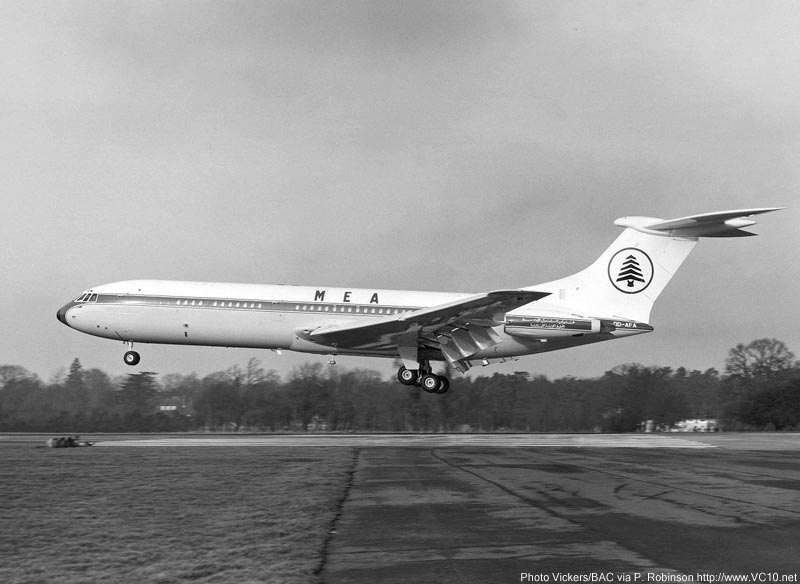
9G-ABP seen at Beirut Airport in MEA colours,
it was here that the aircraft would be destroyed.
Photo via Aviation Photography of Miami collection

Photo copyright BAE SYSTEMS via P. Robinson |
Although Middle East Airlines had wanted to buy VC10s, they never did as at
that time the VC10 story was at its public and political worst. Buying 707s
instead it looked as if this was a missed opportunity, but in 1967 MEA leased
under-utilized 9G-AGP from Ghana Airways to fill the gap until the 707s could
be delivered. For the same reason G-ARTA was also leased, this time from Freddie
Laker's Laker Airways, as OD-AFA. Sadly 9G-AGP was lost in a military action at Beirut Airport
in December 1968, fortunately empty, and G-ARTA went back at the end of its
twelve month lease only a few months later.
Back to Top
Nigeria Airways
|

G-ARVF was apparently also leased as it is seen
here with Nigeria Airways stickers
Photo M. Barrefors via
www.Airliners.net

G-ARVC seen here in full Nigeria Airways colours
while under lease.
Photo via L. Holden

This photo shows that the livery applied to 5N-ABD
(ex-G-ARVA) was different from the one carried by G-ARVC, sadly 5N-ABD
only flew in this livery for a few months before its fatal crash.
Photo via L. Holden |
Nigeria Airways started out along the same route as Ghana Airways, using BOAC
Stratocruisers and Brittanias. It ordered two VC10s type 1104, but these were
never built. In 1964 Nigeria Airways started wet-leasing two BOAC VC10s in basic BOAC
livery with Nigeria Airways stickers. These two flew on until 1966, when
G-ARVC was wet-leased in full Nigeria Airways livery. In 1969 G-ARVA was sold by
BOAC and was re-registered 5N-ABD, sadly this airframe was lost several months
later.
The story of Nigeria Airways and the VC10, and the crash of 5N-ABD is well
presented in Scott Henderson's "Silent, Swift, Superb: The Story of the
VC10". Pages 88 - 93, detailing the story of Nigeria Airways and the VC10,
including the crash, are reproduced on this page:
Nigeria Airways and
the VC10.
With thanks to Mark Hubbard who included the text in electronic form
in his Nigeria Airways VC10 package for Microsoft Flight Simulator 98, which can
be downloaded here.
|

5N-ABD parked at Heathrow.
Photo P. Huxford / Mach III Plus |
Back to Top
Qatar Government

G-ARVJ while being operated for the Qatar
Govenment. |
The ruler of Qatar felt that his position justified the use of an impressive
VIP transport and for this purpose G-ARVJ was put on a long-term wet lease to
the Qatar Government. Although not owned by them the aircraft did fly in Gulf
Air colours, apparently she was sometimes used as a spare aircraft for their
services. It provided an interesting posting for several BOAC (by then British Airways) crews
until it was returned to BOAC, and was sold to the RAF as a spares source for
the conversion program.
See also Surviving Bits & Pieces
for more about its use for the RAF.
Back to Top
Rolls Royce
Needing an aircraft to flight-test the new RB211 turbofan engine, Rolls-Royce
wanted to lease a VC10, initially going for 9G-ABP. That airframe burned out in Beirut in 1968 and RR then leased XR809 from the RAF as G-AXLR. At the end of the flight-test program the
aircraft was returned to the RAF but never used again.
Back to Top
Royal Aircraft
Establishment
When British Caledonian sold its VC10s, one of the three aircraft found its way to the Royal Aircraft Establishment
Bedford as XX914. Over the next two years this aircraft was used for
several research tasks, mostly to do with structural responses.
In May 1975 she was withdrawn from use and stored on the site until the scrapman caught up with her in 1983, but some of her parts were
still of use. The fuselage was moved to Brize Norton and used for training by
the Air Movements School as 8777M. The vertical tail was used as a replacement
for ZA141, whose tail had been damaged during resonance testing at altitude.
For more about the remaining sections of this aircraft see
Surviving Bits & Pieces
| XX914 |
1973 - 1983 |
WFU, scrapped |
Back to Top
Sultan of Oman Royal Flight

Photo J. Hieminga |
As the Sultan of Oman was also in need of VIP transport he had G-ASIX
extensively modified and used it as A4O-AB for thirteen years. The aircraft was
flown back to the United Kingdom in 1987 and donated to the Brooklands Museum
for preservation. The Sultan's transportation needs have since been provided by
a suitably equipped Boeing
747SP.
Back to Top
Sierra Leone Airways

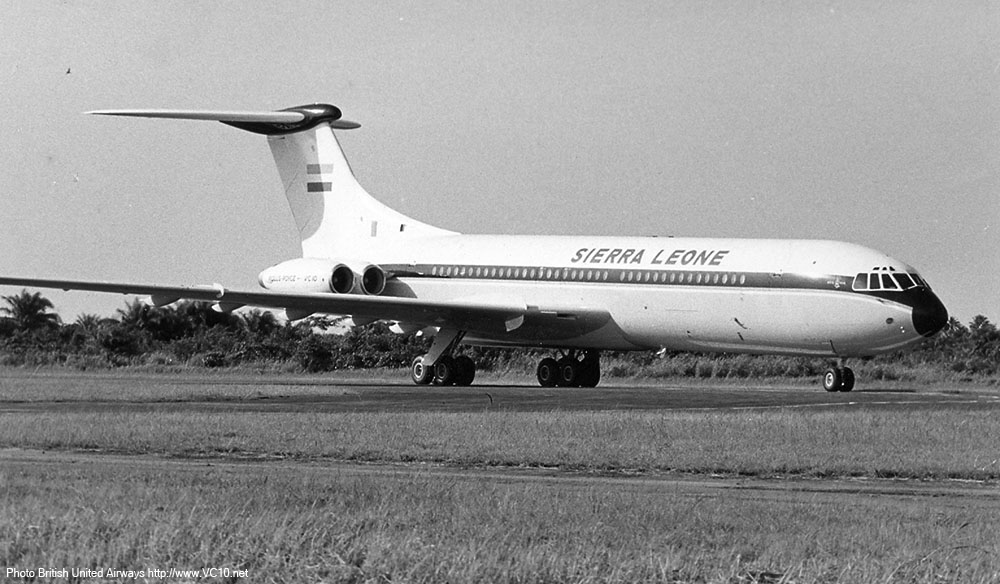
This BUA publicity photo shows the full Sierra Leone livery on G-ASIW (most likely, based on the underwing fences) at Freetown in late 1964.
Photo BUA via P. Moreu |
In one of Freddie Laker's dealings a BUA VC10 was used on Sierra Leone
Airways flights, replacing a Britannia from November 1964 on, at first operating in full SLA livery. This colourscheme was short lived, most of the time stickers were used in addition to the BUA colours. Based on the rare photos it was G-ASIW that carried the full Sierra Leone titles in late 1964.
Back to Top
United Arab Emirates
Government

Photo J. Hieminga |
The third Arab government to use a VC10 for transportation was the United
Arab Emirates government. They bought G-ARVF off BOAC and after conversion it
flew for seven years in an attractive white livery. Today this aircraft is
preserved in Germany with the Flugausstellung
Junior in Hermeskeil.
Back to Top
|