|
Send E-mail |
An aircraft is sometimes described as 80000 parts flying in close formation, and while most of these parts are fairly straightforward and found on most designs, the VC10 has some peculiarities that are not commonly found on an airliner. They deserve some attention. Obviously when mentioning periscopes many people will think of submarines. They are however not the only vehicle using them. While it seems a bit strange the VC10 was designed to have a periscope included in its equipment. And not just one, but two. The reason behind this is fairly straightforward: as a pilot you sometimes want to see what's happening with your aircraft. And with that great big tail at the back, well, there's just no window through which you'll be able to get a look at what's happening up there. Normally this will not be a problem, but when you encounter icing conditions you might want to know how this is affecting your aircraft. The wings can be seen through the cabin windows, but not the tail and for this there is the periscope.
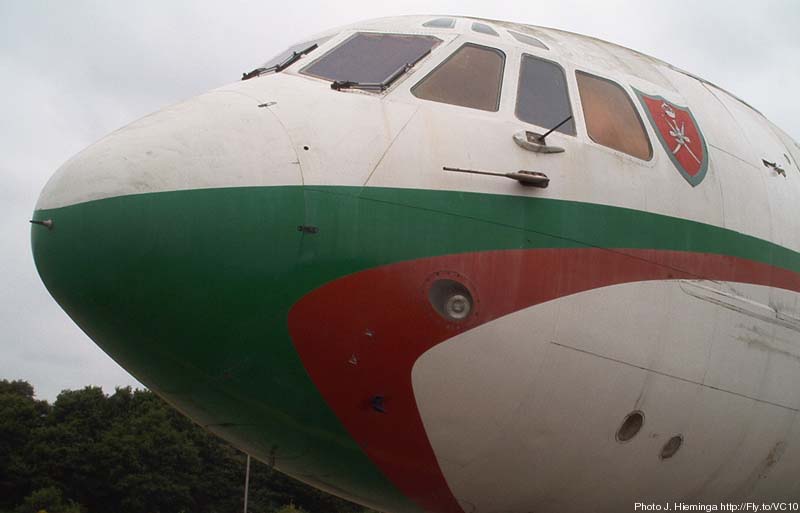
Normally the periscope will be stored in its box somewhere in the back of the aircraft. In A4O-AB, the Sultan of Oman's aircraft, this box is kept in the aft galley. The periscope itself is about two and a half feet in length, and is a pretty sturdy piece of ironmongery. There are two mountings for the periscope in the roof of the fuselage, which are similar in design, both to be found just in front of the rearmost toilets in the aircraft. These can be revealed by undoing two quick-release catches on one of two small triangular panels in the roof. This provides the sight below.
The large hole on the right is the actual mounting into which the periscope is inserted. Once inserted partly, a catch is released and then the large lever can be pulled down which opens the small hatch and allows the periscope to be fully inserted, which has it protruding some three to five inches from the fuselage top. A catch keeps the periscope from falling down again, this catch is released with the small lever on the left, after which the hatch can be closed again. Preferably this is done before the periscope is completely removed from the mounting as it can get a bit drafty otherwise. In the photo above, the small notice reads: 'Periscope operation - The large handle operates the pressure flap - The small handle operates the catches'.
In its installed position the periscope can be rotated 360 degrees, and the control on the side tilts the prism at the top about 40 degrees from slightly below level to 30 degrees above the level angle. All together you can look all the way around the aircraft, except for straight up at the sky (but there shouldn't be much to look at up there anyway). By switching from one mounting to the other both sides of the fin can be viewed. From the lefthand mounting, looking to the right wingtip will have you looking at the base of the fin as the periscope sticks up right next to it.
This same periscope can also be mounted in two other locations. The first of these is in the cockpit roof. The mounting installed here was meant originally for use with a periscopic sextant, but will also take the periscope. During BOAC crew training flights where Dutch Roll characteristics were demonstrated trainees were sometimes given a chance to view the back end of the plane from here to see the effects. The second location is located in the bottom of the fuselage and was included to enable the crew to check the status of the landing gear if any uncertainty about its position was present amongst the crew. It consisted of an opening in the electronics bay access hatch located underneath the fuselage. Unlike the others there was no pressure shutter to cover this opening - it was just a plug that could be removed and replaced with the periscope - since it would generally only be used at lower altitudes where the pressure differential would be lower. Still it has been confirmed to me by an ex-BOAC First Officer that the plug could be removed when flying at 39000 feet, although this needed quite a pull and the result was quite noisy!
And what about the second periscope then? To find this piece of equipment we will have to look around the back galley area. Somewhere in this area there will be a small piece of floor covering (about 6 by 6 inches) that can be lifted up. Underneath is then a small tube with a prism at the bottom that can be lowered into the aft cargo hold. The reasoning behind this small periscope is the fire-surpressing capability of the cargo hold. If a fire should exist in the cargo hold then the detection system will pick this up, but there are no extinguishing agents at hand to use. Basically the cargo hold is designed to be sealed so that the fire will die from oxygen starvation. As a fire warning can also be due to a faulty detection system the periscope is a simple device that can confirm or deny the existence of fire. Another reason for looking through it could be to confirm that a fire has actually died out, as a quick landing might be in order if it hasn't. Mind, I myself wouldn't want to be there on the floor watching a fire eating away at the aircraft I'm on.
These small pieces of equipment should be classified as belonging to the pressurization system of the VC10. A bit of background on this: the cabin of an aircraft is pressurized by pumping in compressed air at a constant rate and the cabin pressure is then regulated by varying the amount of air that leaves the cabin again through the outflow valves. On the VC10 the outflow valves are located at the left front of the fuselage next to the nosegear bay, and in the tail of the aircraft. Four Godfrey compressors mounted on the engines and driven from the engine gearbox provide the compressed air and this is constantly fed to the cabin via the airconditioning system which manages temperature and humidity.
From the above it is clear that there will be a constant flow of
air leaving the aircraft through the outflow valves. Someone in the design
office saw this as a waste of energy and designed the thrust augmenters to
recuperate some of this energy. The thrust augmenters are two small tubes
mounted at an angle in the fuselage side, one at the right front just behind the
nosegear, and another below the righthand side engines. These tubes are angled
towards the rear and through a switch mounted on the flight engineers panel
valves are opened in these tubes allowing cabin air to exit through them. The
tubes are about two inches in diameter and the amount of air passing through
them will result in the outflow valves closing fractionally to keep the cabin
pressure constant.
This same air flowing through the augmenters, being angled back will provide a small bit of forward thrust. I am guessing that the amount of thrust produced by this system cannot be measured in knots of speed gained, but still, over a longer flight it could well have saved a small amount of fuel with the added weight to the aircraft being fairly small. It does seem a bit strange to have this system installed on the right side only, but as the forward outflow valve is mounted on the left side, I'm guessing that the sideways force created by the angle in the thrust augmenters will oppose the same effect from the outflow valve. The next question will be why the outflow valves themselves are not angled like the thrust augmenters, making full use of the potential. The main reason for not doing this is probably because of the size of the outflow valve assembly. Also because of the range of pressure differentials that the system needs to care for the pipe from the outflow valve has a much larger diameter than the thrust augmenter and this will not provide the same amount of thrust as a smaller diameter pipe for the same pressure differential. The Engine/Airframe course notes for Ground Engineers have this to say about them: "The thrust augmenters are normally used above an aircraft altitude of 35,000 Ft to enable the exhaust airflow from the cabin to be usefully employed in giving a percentage of additional thrust to the aircraft”. In an article in Flight International from 10 May 1962 it is estimated that the thrust augmenters would generate a fuel saving of 50 Lbs/hr. A small addition to this subject from Martyn Taylor is the following thought: "It was always my understanding that the reason the thrust augmenters were fitted to the right-hand side of the fuselage was to offset the extra drag created by the fifth engine that could by carried under the starboard wing." Perhaps this was true, but I cannot confirm nor deny it, anybody else with more info? Oh, and more about the fifth engine pod later!
An interesting sidenote to this item is provided by the page reproduced here from the Concorde Component Location Handbook. In the chapter for Pressurization Control item 4 on this page seems a bit familiar: Thrust Recovery Nozzle. Mounted at a 45 degree angle (or thereabouts) behind the nosegear bay are two of these items and from the drawing it looks suspiciously like an improved version of the thrust augmenter described above. On the Concorde a louvred exhaust is included which is operated by a pressure switch. It is interesting to see that the ideas that were present when the VC10 was designed may have found its way into what is still regarded as the masterpiece of aeronautical engineering: Concorde. Another airplane which uses this idea is the McDonnell-Douglas DC-10 (built between 1970 and 1988), which is fitted with a Thrust Recovery Valve. When the VC10 was designed the reliability of the available jet engines was not as good as it is today. Because of this the chance of having an engine failure was more significant and this warranted some creative thinking about the situation. What to do if a VC10 was stranded somewhere with a failed engine? Vickers' solution was to arrange for a pod that could be attached to the wing root on the righthand side and which was capable of holding a spare Rolls-Royce Conway engine. With this setup the spare engine needed could be carried (for a small fuel penalty of course, the EAA Performance manual states that 6% should be added to the trip fuel) by another VC10 on a regular revenue flight to relieve the stranded aircraft. The alternative of flying in an engine by specialized freighter with its associated costs could then be avoided. The pod itself was designed and built by Freddie Laker's Aviation Trader's Engineering at Southend. The VC10 was not the only aircraft to use a solution like this. When the 747 entered airline service in 1970 it had a mounting under the left inboard wing for an extra spare engine. The 747 was the first wide-body airliner but also the first to use high bypass engines in the shape of the Pratt & Whitney JT9D. This engine was at that point too large to fit into anything but a specialized freighter aircraft, and because of this Boeing used the same trick as Vickers had done on the VC10. Next to these the Tristar, DC-10, 707 and DC-8 were also airliners to use this method. Eventually the use of a spare engine mounting disappeared as wide-body freighter aircraft (especially Combi-aircraft carrying both passengers and freight) became available. Now it became possible to carry an engine inside the fuselage without the fuel penalty caused by the drag of the fifth engine.
The pod itself consists of several items. The main part is a frame that links the mounting points on the engine to the four attachment points under the wing. This same frame also supports the aerodynamic shell that is fitted around the engine. This shell starts with two top halves which are bolted to the main frame between the engine and the wing. A single bottom half is fitted to the top with quick release fittings, this same type of fitting is then used to fasten a front and rear section. A few small panels then close off the remaining gaps between the pod and the wing and she is ready to go. Avion's DVD 'Classic Wings - VC10' has a piece of film that shows how such a pod is put together around a spare Conway engine.
Ex-EAA Captain Arthur Ricketts shared his memories of the engine carrying pod, see here: Memories - The Pod
In the 21st century we have become used to seeing carbon fibres as the base material for a lot of different objects and even whole aeroplanes. This was not the case in the late 60s. It wasn't until 1963 that a patent was registered by the RAE at Farnborough for a process that delivered long, stiff and light fibres. These could be incorporated into a matrix material to form Carbon Fibre Reinforced Plastics (CFRP) as they are now known. By that time the VC10 was already flying and the use of composites in the VC10 design was restricted to panels of glass-fibre reinforced material on for example the flap falsework. The VC10 however did play a part in some research projects that led to the common use of this material that we see today. In the late 1960s Rolls-Royce was working on a new engine to power the Lockheed Tristar widebody that was on the drawing board in Burbank California. Apart from the revolutionary three-spool design the engine was to feature fan blades made of a new material called 'Hyfil'. This was to use the recently developed carbon fibre together with a honeycomb core to create a fanblade that was very much lighter than an equivalent metal blade. As part of the testing process the material was used to create a set of fanblades for the VC10's Conway engines and these were flown in normal airline service to obtain in service experience. The BOAC Engineering News (see above) about these trials included many photos of possible damage to these blades as noone had any experience with carbon fan blades and it was important that engineers could analyse whether a blade was safe for further use. Initially, only two engines were fitted with these blades (No.7030 and 7066) with the restriction of using only one of these per airframe. On 30 July 1968 G-ARVL was flying an approach into Lagos, Nigeria through heavy rain when engine three began to run rough and had to be shut down. After landing the engineer found the fan to be completely shredded with the fibres of the fanblades just holding the loose bits together. A few years later the Hyfil blades for the RB211 were found to be incapable of surviving the bird impact test and after a bankruptcy and nationalisation the RB211 ended up with titanium blades.
Carbon fibre has many more uses than fan blades though and another development was a combination with honeycomb material to create a carbonfibre sandwich that could be used in floor panels. Super VC10 G-ASGF would fly for over eight years with the first carbon fibre floor panel to be used in airline service. Some of the initial problems with panels receiving impact damage, especially from ladies high heels, were overcome and today every airliner uses composite floor panels, saving many pounds of weight. Other Carbon/Nomex test panels have also been fitted to G-ASGB and G-ASGD at times, but these tests were not as long-lived as the one on G-ASGF. On 'GB, a panel fabricated to underseat specifications was intentionally fitted in a gangway location to get an early failure (after 7500 hours it did indeed suffer a compression failure over a floor beam). The two exhibits shown in the photos above are on display at the Farnborough Air Sciences Trust. They are part of a display that highlights the part played by the RAE in the development of carbon fibres. Another popular use for carbon fibre in aviation is in brake discs. The first carbon-carbon disks for use in aircraft were designed by Goodyear for military applications, but Dunlop licensed the process and started development of a brake pack for Concorde. In 1972-1973 BOAC Super VC10 G-ASGE was used to test a 20in version of this brake design in normal airline service. Concorde later became the first civil airliner to use carbon as a brake material. Sources: Armstrong, K.B. (1974) 'Aircraft floor panel developments at British Airways (1967-1973)', Composites, July 1974 issue p165-173 & Farnborough Air Sciences Trust. |