|
Send E-mail |
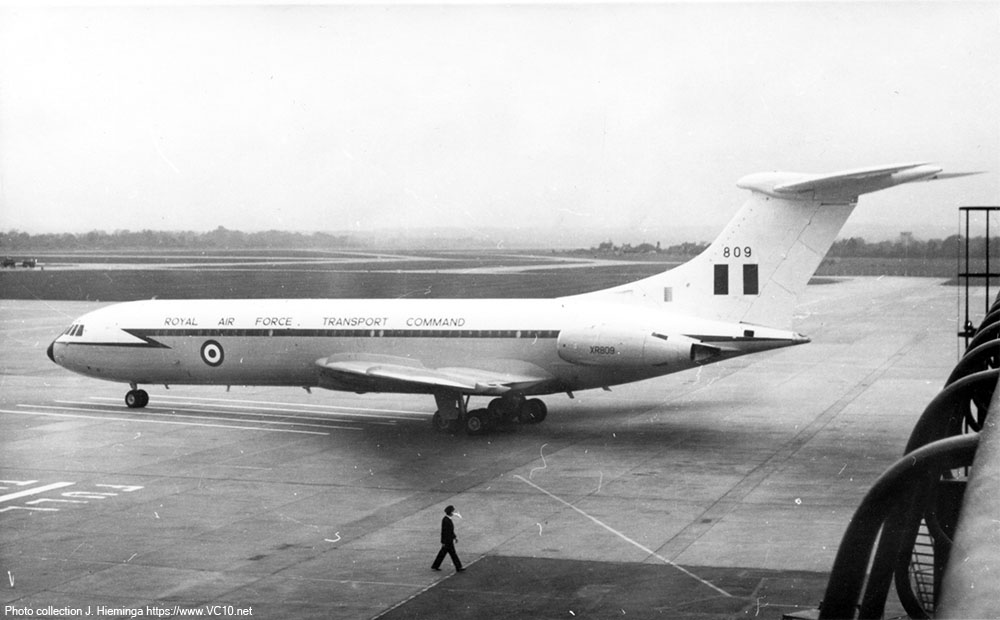
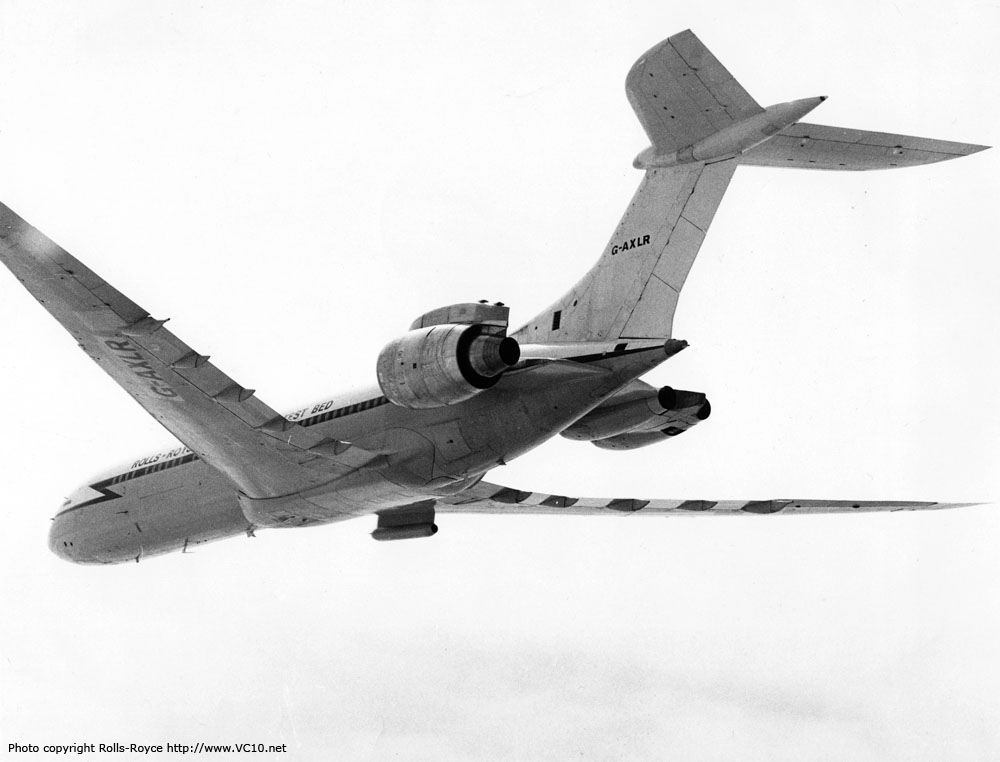
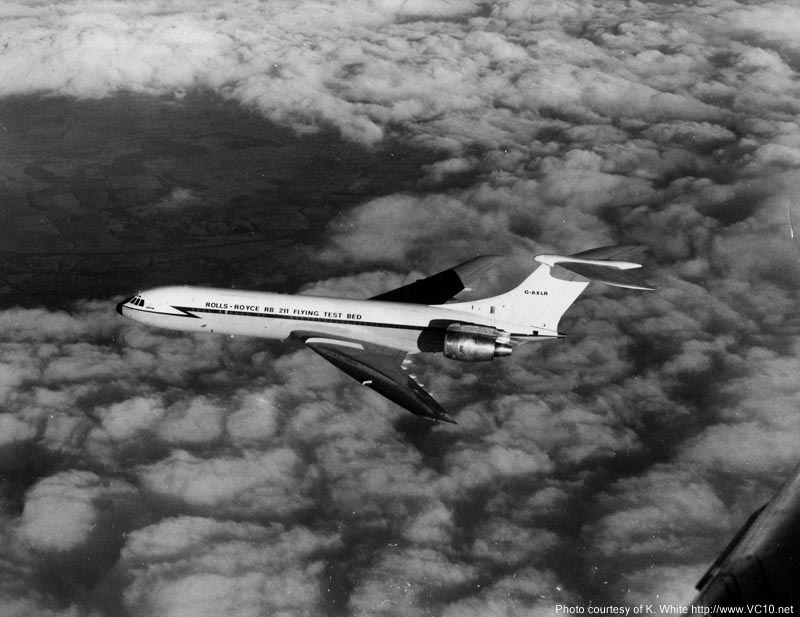
G-AXLR in flight showing the RB211 test engine Photo D. Slaybaugh Construction number 829 was built for the Royal Air Force as the fourth example of a type 1106 VC10. These type 1106s could be described as 'hot-rods', as they combine the Super wing and the more powerful RCo.43 engines with the original length Standard fuselage and therefore they did not trade performance for capacity as the Super VC10 did. XR809 flew for three years with RAF 10 squadron, named 'Hugh Malcolm VC', but when the original plan to lease 9G-ABP was thwarted, the RAF stepped in and leased their fourth aircraft to Rolls-Royce as a flying test bed for the RB211 turbofan engine. At that time no aircraft was available in the UK that could accommodate the large girth of the RB211 beneath the wing and still have some ground clearance left. The mounting on the side of the fuselage of the VC10 did provide this clearance and with the clean wing and relatively high fuselage mounting the RB211 was in clean air and therefore the test results would be universally acceptable. To be able to attach the RB211, the engine beam was strengthened to accommodate the higher weight and aerodynamic effects of the larger frontal area. Also, as the RB211 was designed for a pylon mounting, some other modifications were needed to adapt to the side-mounted VC10 pylon. All went well and the first flight of the three-engined VC10 took place on 6th May 1970. On take-off, the two starboard Conways were marginally more powerful than the one RB211.
Reregistered as G-AXLR, the aircraft commenced on an extensive flight test programme. Initially it flew from Hucknall, but from May 1972 on the aircraft was moved to Filton from which many more flights were made. One hair-raising flight was the test bed's 44th flight on 7th august 1972. This was the first flight with a new pressure switch to prevent deployment of the thrust reverser on the RB211. With an expected flight time of five hours the aircraft took off laden with fuel. An initial warning light for the thrust reverser was investigated, but the crew decided to continue the flight as they didn't want to dump fuel this early in the flight. After an initial performance test run at 250 knots at 20,000 feet, the aircraft was being prepared for a second run at 300 knots when the cold stream reverser of the RB211 slid back into the reverse position, sealing off the bypass duct. The effect of this was a reverse idle which produced an initial slight lurch on the aircraft. Shortly afterwards, a more violent lurch occurred, followed by aircraft buffet. There was adverse yaw and roll, and the throttles were closed, initiating a descent before recovering to wings level. Full power was set on the Conways but level flight could not be maintained. The aircraft continued to descend at 2,500 feet per minute as the RB211 was windmilling with the reverser extended.
Fuel jettison was initiated as the equation was quite clear to all on board - the aircraft would hit the ground in approximately twelve minutes unless the weight could be brought down to a value that the Conways could cope with. As the VC10 was aimed at the Bristol Channel, the crew was running through their sea survival kit and ditching drills. As the weight came down, the rate of descent improved, until, at 3000 feet, the aircraft weight was low enough to enable level flight on the thrust available. Fuel dumping was stopped at the coastline and the crew briefed for the approach and landing procedure for this new configuration. A go-around would not be possible with the drag of the RB211 and the available power on the Conways. A safe landing was carried out after a careful, wide circuit. After this, modifications were carried out to the pressure switch as it turned out that it was measuring the wrong pressure. The RB211 test programme spanned five and a half years but during that time the VC10 test bed only spent 216 hours and 45 minutes in the air. The planned endurance testing, which should have clocked up 1,000 flying hours over a period of nine months, was cancelled as other development issues surrounding the Hyfil fan blades, engine weight issues and surge problems slowed down development of the engine. And once the TriStar prototype was flying it could build up engine flying hours three times as fast as the VC10 could. On 26th September 1975 the aircraft was delivered to RAF Kemble. Initially the aircraft was meant to return to RAF service but it was found that the airframe was distorted and repairs were deemed too costly. In the end the airframe was used for SAS training purposes and was left to decay at the site, eventually being scrapped. When later on Rolls-Royce needed to flight test the RB211-535CF and RB211-535E variants the Boeing 'house' 747 had to be hired for two 30 hour demonstrations at a total cost that just fell short of $10 million. As all the original RAF VC10s were named after VC holders and the intention was that G-AXLR would return to RAF service, the scroll honouring Hugh Malcolm VC stayed on the airframe during its time with Rolls Royce. A photo below shows that the section carrying this scroll was cut from the aircraft during its time at Kemble, sometime between 1977 and 1982. This bit of fuselage is in the RAF Museum's storage. In 2011, when the names from other VC10s which were taken out of service were transferred to previously unnamed 101 Squadron VC10s, the question of what to do with Hugh Malcolm VC came up. It was decided that this name would be added to XR808 and so after 35 years the memory of this courageous VC holder once again flew on a VC10. More Info G-AXLR Test Flying is test pilot Dennis Whitham's own account of the thrust reverser incident. Timeline
More Images
1. Seen here at an unknown location, XR809 as a 10 Squadron VC10 sometime before November 1968 as the airframe has not been named yet.
1. The mixed RAF/Rolls-Royce crew, having delivered XR809 to Hucknall. LtoR: Geoff Bowles, unknown, Alf Musgrove, Cliff Rogers, Dennis Whitham, Brian Lingard, John Butcher.
1. A great inflight photo, most likely taken from the chase plane during this same first flight. The coloured tip of the fin bullet appears to have been retouched, perhaps it distracted from the overall white theme of this photo. 1. Several
views of G-AXLR undergoing servicing with the RB211 mounted.
3. A second press release, this one from Rolls-Royce, with a photo showing G-AXLR in flight. It looks similar to the photo below (no.3) which may have been taken on the same occasion. The full text that accompanies the photo is:
4. Test flying the modified VC10 was the responsibility of Rolls-Royce pilot Cliff Rogers, who was accompanied on at least one occasion by a Lockheed colleague, as this press photo shows:
All images above provided by K. White except where noted
1. Ground tests on the RB211 with an unidentified group of engineers in attendance.
1. G-AXLR airborne during tests with the
RB211.
1. In 1970 G-AXLR showed the three-engined layout to visitors
at the Farnborough Airshow.
1. Another shot of the derelict airframe, the tail on the left
is an ex-Dan-Air Comet.
1. Schematic of the instruments fitted to G-AXLR for its role as engine testbed.
Sources: 'Three's Company', Aeroplane Magazine, March 2026.
| ||||||||||||||||||||||||||||||||||||||||||||||||||||||||||||||||||||||||








)