|
Home
Up
C/n 801/2 - Test Specimen
C/n 803 - G-ARTA
C/n 804 - G-ARVA - 5N-ABD
C/n 805 - G-ARVB
C/n 806 - G-ARVC - ZA144
C/n 807 - G-ARVE
C/n 808 - G-ARVF
C/n 809 - G-ARVG - ZA141
C/n 810 - G-ARVH
C/n 811 - G-ARVI - ZA142
C/n 812 - G-ARVJ - ZD493
C/n 813 - G-ARVK - ZA143
C/n 814 - G-ARVL - ZA140
C/n 815 - G-ARVM
C/n 819 - G-ASIW - 7Q-YKH
C/n 820 - G-ASIX - A4O-AB
C/n 823 - 9G-ABO
C/n 824 - 9G-ABP
C/n 825 - G-ATDJ - XX914
C/n 826 - XR806
C/n 827 - XR807
C/n 828 - XR808
C/n 829 - XR809
C/n 830 - XR810
C/n 831 - XV101
C/n 832 - XV102
C/n 833 - XV103
C/n 834 - XV104
C/n 835 - XV105
C/n 836 - XV106
C/n 837 - XV107
C/n 838 - XV108
C/n 839 - XV109
C/n 851 - G-ASGA - ZD230
C/n 852 - G-ASGB
C/n 853 - G-ASGC
C/n 854 - G-ASGD
C/n 855 - G-ASGE
C/n 856 - G-ASGF
C/n 857 - G-ASGG - ZD235
C/n 858 - G-ASGH
C/n 859 - G-ASGI
C/n 860 - G-ASGJ
C/n 861 - G-ASGK
C/n 862 - G-ASGL - ZD240
C/n 863 - G-ASGM - ZD241
C/n 864 - G-ASGN
C/n 865 - G-ASGO
C/n 866 - G-ASGP - ZD242
C/n 867 - G-ASGR
C/n 881 - 5X-UVA
C/n 882 - 5H-MMT - ZA147
C/n 883 - 5Y-ADA - ZA148
C/n 884 - 5X-UVJ - ZA149
C/n 885 - 5H-MOG - ZA150
Send E-mail
Note: Remove the last section from the e-mail address before
sending!

View My Guestbook
Sign My Guestbook
| |
C/n 807 - G-ARVE
Timeline
| Date |
|
| 16 January 1963 |
Registered as G-ARVE to BOAC, the G-ARVD registration was skipped as an overly puritanical lady at the ARB felt that the last two letters were unacceptable in nice company. |
| 15 April 1963 |
First flight. |
| Late April 1963 |
Returned to Brooklands to have the slats and engine nacelles modified. |
| 7 May 1963 |
Rejoined test programme at Wisley. |
| Summer 1963 |
Used for drag reduction trials. Sent to Fields Aircraft to have the engine pylons modified into Super VC10 configuration. Modified back to type 1101 configuration at Fields after completion of trials. |
| 18 December 1963 |
Ferried to Marshall of Cambridge for removal of testing equipment and refurbishment to production standard. |
| 31 August 1964 |
After completion at Cambridge, the VC10 flew back to Wisley where it continued in the testing programme until delivery. |
| 1 October 1964 |
Delivery to BOAC as G-ARVE. |
| September 1972 |
Suffered severe wing drop during an air test, caused by a missing wing fence seal. |
| 1 April 1974 |
Ownership transferred to British Airways Board. |
| 23 October 1974 |
Operated last flight Tehran - Beirut - London. Accumulated a total of 36254.13 hours and 13460 landings. Taken out of service and stored at Heathrow. |
| September 1976 |
Scrapped at Heathrow, together with 'VB and 'VH. According to Boeing the airframe had been cannibalised by the time it was scrapped. |
| 7 October 1976 |
De-registered and transfered to 'unqualified owner', actually Boeing, in part exchange for 747s. Note states 'to USA for destruction' but the aircraft was obviously never put on the US register. |
Photos
Photo copyright BAE Systems / collection J. Hieminga |
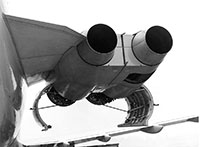
Photo copyright BAE Systems / collection J. Hieminga |

Photo copyright BAE Systems / collection J. Hieminga |

Photo copyright BAE Systems / Brooklands Museum archives
|
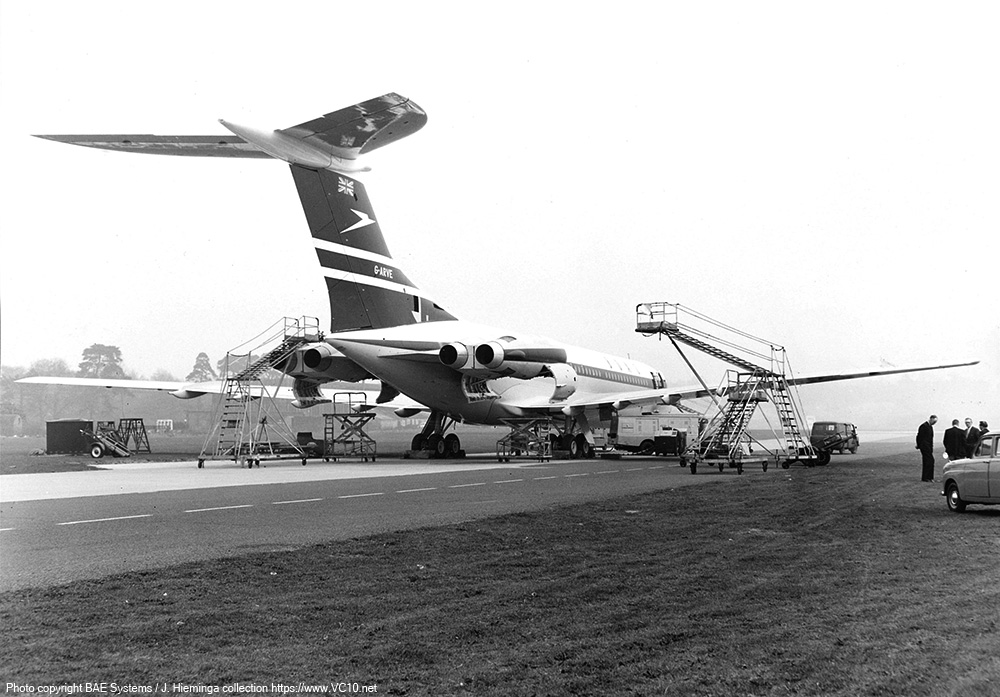
1. G-ARVE at Brooklands prior to or just after its first flight, undergoing engine testing on a stretch of taxiway between the flight sheds and the main runway.
2. This photo, most likely taken on this same day, shows a modified stub wing configuration on this Standard VC10.
3. G-ARVE is seen here at Wisley after its visit to Fields Aircraft. The engine nacelles have been modified to the Super VC10 configuration, tilted up by three degrees and moved outboard by about eleven inches. After test flying this configuration the aircraft went back to Fields to have the nacelles
restored to the type 1101 configuration. The temporary 'Beaver tail' fairing has a chisel shape that was not used for the final design.
4. The small kink in the leading edge next to the fuselage is normally only seen on a Super VC10.

Photo copyright BAE Systems / Brooklands Museum archives |
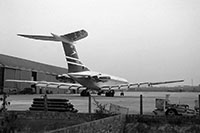
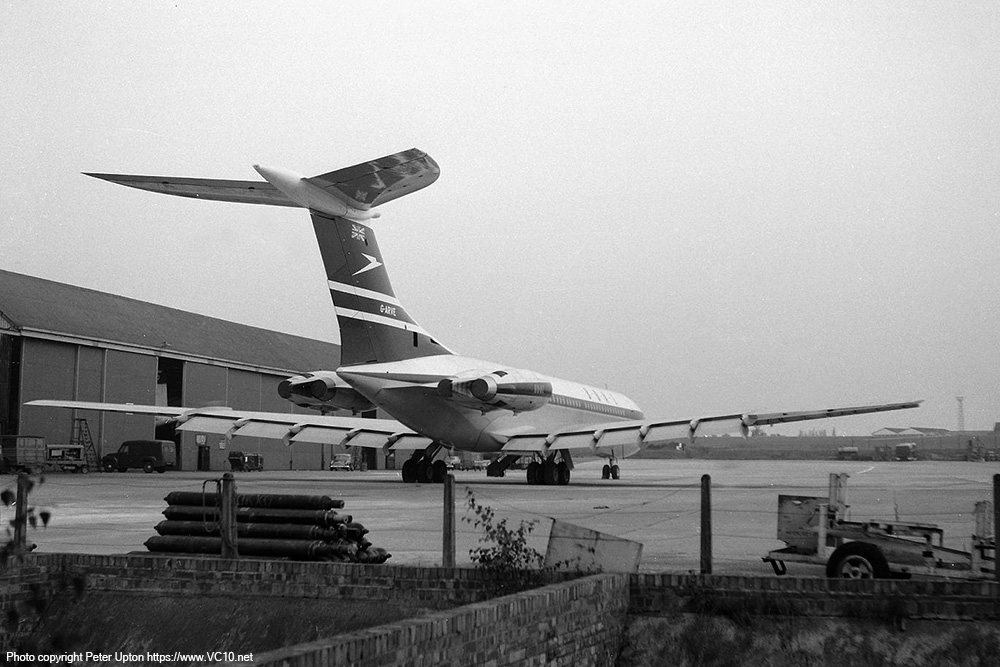
Photo copyright Peter Upton |

Photo copyright BAE Systems / via Guy Burden |

Photo copyright BAE Systems / Brooklands Museum archives |
1. The back end of the engine nacelle shows the stepped rear edge of the stub wing which was also present on the Super VC10s. The 'Beaver tail' fairing installed here shows a pointed version that was later used on some Super VC10s.
2. Peter Upton took this photo of G-ARVE on the Wisley apron during one of his visits to the testing site.
3. G-ARVE parked on the Wisley apron during testing with the modified nacelles with another Standard VC10 in the background.
4. The location for this photo is unknown, but it was taken on 7th May 1963 and G-ARVE still had the squared off wingtips that were changed before entering service.
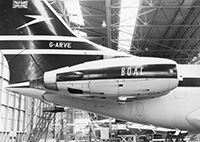
Photo copyright BAE Systems / Brooklands Museum archives |

Photo copyright BAE Systems / Brooklands Museum archives |
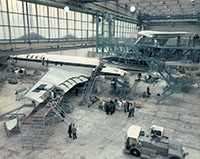
Photo copyright BAE Systems / Brooklands Museum archives |

Photo J. Downey |
1. A side view of the engine nacelles taken in the large hangar at Wisley.
2. This overhead view shows the modified nacelle and stub wing while G-ARVE is undergoing maintenance or being modified.
3. G-ARVE (or perhaps G-ARVF, I cannot be 100% sure) inside a BOAC hangar undergoing servicing. This was part of the process of introducing the type to the airline, enabling the engineering and maintenance staff to get acquainted with the new type.
4. John Downey flew on G-ARVE in February 1965, from Beirut back home to London Heathrow, and took this photo after landing.

Photo collection J. Hieminga |

Photo collection J. Hieminga |

Photo Petr Popelár - archív |

Photo collection J. Hieminga |
1-2. On 7th May 1966 G-ARVE was seen at a South African airfield, in service with BOAC.
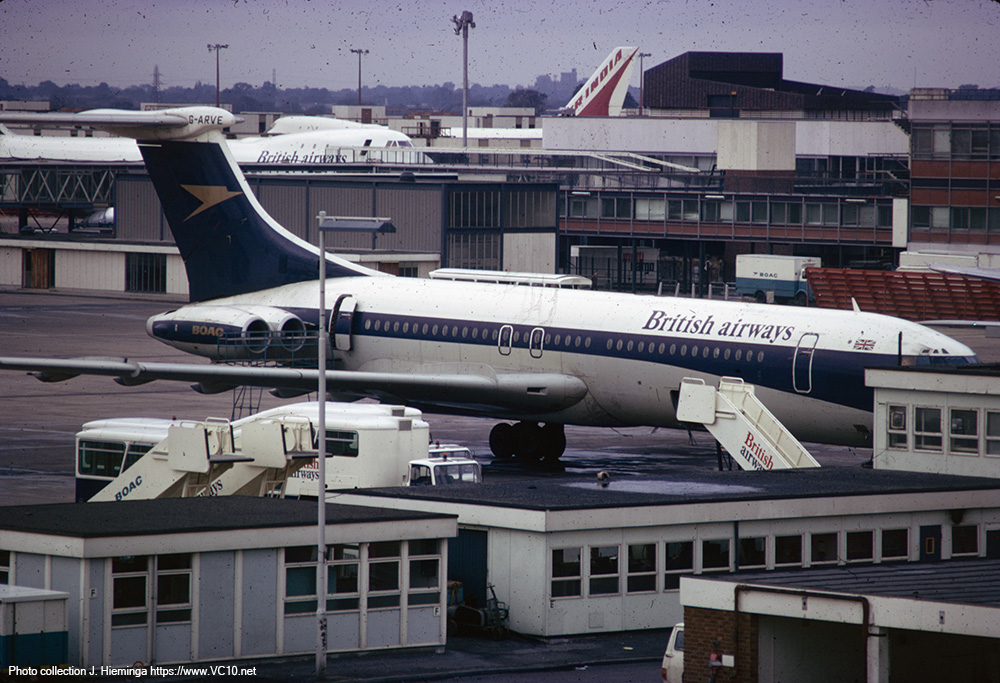
3. Like the other Standard VC10s, G-ARVE was repainted into BOAC's first 'Golden Speedbird' scheme before starting service with BOAC. Although the Supers were repainted into the second version of this scheme before entering service in 1965, G-ARVE still wears the first version in August 1967.
4. G-ARVE parked at Heathrow next to a BOAC 707 and Super VC10 G-ASGA.

Photo A. Pollard |

Photo L. Söderström |

Photo collection J. Hieminga |
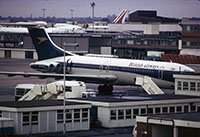
Photo collection J. Hieminga |
1. G-ARVE departing Entebbe in 1970.
2. This photo taken at London Heathrow in 1972 shows G-ARVE operating a flight for Gulf Air. The BOAC titles on the front fuselage have been covered by Gulf Air stickers.
3. Prestwick August 1973, G-ARVE is parked on the Apron while a re-branded 707 is being marshalled to its stand.
4. This scanned slide shows G-ARVE at the gate at London Heathrow. Taken around September 1974, this must have been during the final weeks of this airframe's service life.

Photo S. Fitzgerald |

Photo copyright Paul Davis |

Image via P. Robinson |

Image via P. Robinson |
1. G-ARVE was stored at Heathrow in 1974, two years later the airframe was scrapped having been used as part exchange for new 747s from Boeing.
2. The airframe was torn to pieces on the apron in front of TBA, in view of all the employees walking from the TBC carpark to their offices in TBA.
3-4. The Daily Mail ran this article about the scrappings at Heathrow in September 1976.
Colourschemes
| Vickers /BOAC |
BOAC scheme of white over grey fuselage, dark-blue cheatline and fin with two white bands over fin. |
| BOAC |
First version of BOAC 'Golden Speedbird' scheme with stepped, gold-edged dark-blue cheatline. Grey lower fuselage and white upper fuselage. Dark-blue fin with gold speedbird logo. |
| BOAC |
Second version of BOAC 'Golden Speedbird' scheme, golden edge on cheatline removed and cheatline now arcs smoothly down towards the nose without the step of the previous scheme. |
| BOAC/BA |
As above but with British Airways titles on the forward fuselage. |
Back to top
|