|
Send E-mail |
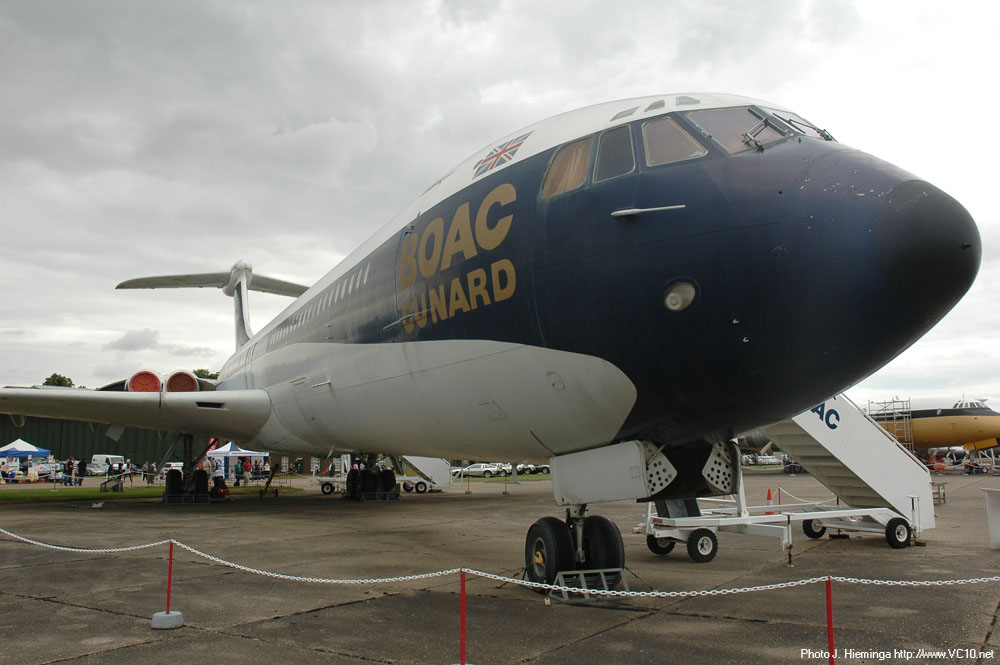
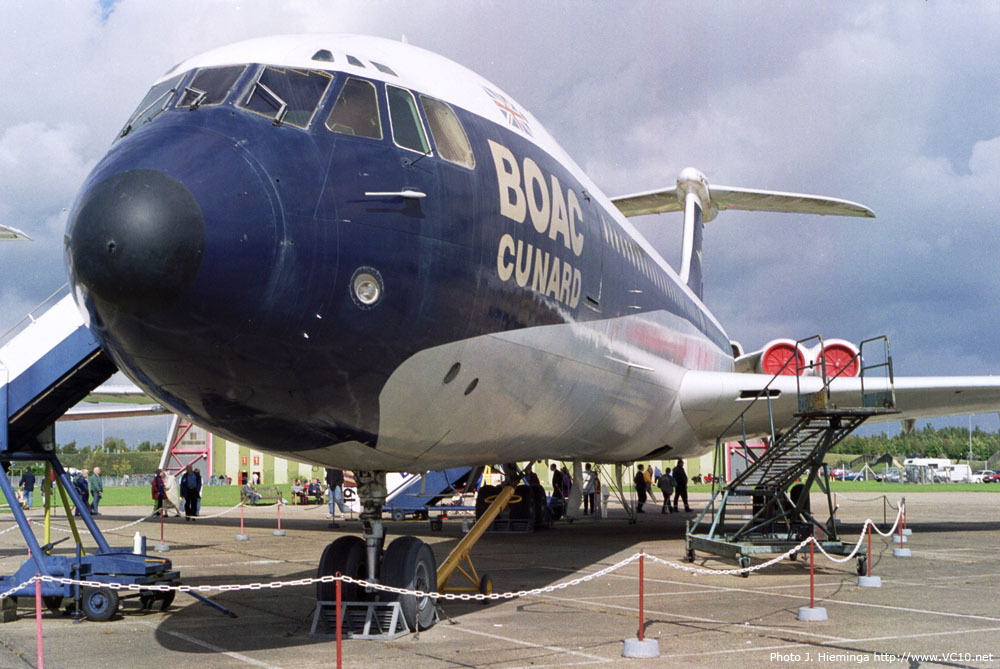
G-ASGC seen at Duxford in October 1999 Photo J. Hieminga G-ASGC is one of the more accessible of the VC10s these days as it is one of several airframes currently preserved in museums. Since 1980 she can be seen at Duxford, in the care of the Duxford Aviation Society (DAS). Obviously life didn't start out for her that way. G-ASGC was built for BOAC as the third Super VC10 ordered by BOAC and flew for the first time on the first day of the year 1965. Most of the development work for the Super VC10, which still was a new type even though there is a lot of commonality with the Standard model, was done by G-ASGA, which first flew in May 1964. Even so the next Supers to emerge from the production line were also needed in this program, with G-ASGC flying 20,5 hours in 8 seperate flights. On 29th January 1965 'GC was issued with a Certificate of Airworthiness and along with G-ASGD was loaned to BOAC (the official delivery date for G-ASGC is 27 March 1965) for initial crew training at Shannon, arriving there on 8th February 1965. But before she left Wisley 'GC was extensively photographed to star in the extensive advertising campaign that BOAC mounted before service entry of the Super.
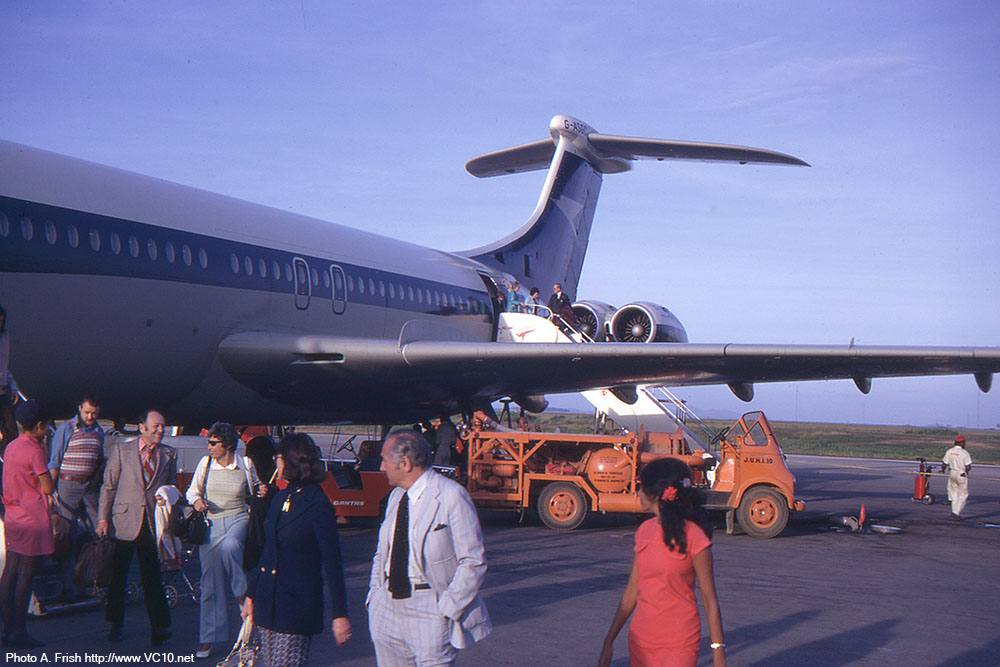
Crew training on the Super VC10 was pretty straightforward, because of the similarities between the Standard and Super VC10s BOAC crews were licensed to fly either version, something that may seem normal now but which wasn't all that common then, and probably saved BOAC a lot of money in those days. Compared to the Standard, the Super will handle slightly differently in overspeed situations and because of the different engines (Conway 550 instead of the Conway 540) power settings were different. Apart from that the pilots obviously had to learn a new set of weights and speeds but they also soon found out that the excellent flying qualities of the Standard were also present in the Super VC10. The major reason for developing the Super VC10 were the relatively high seat-mile costs of the Standard VC10 when compared to the main competitors. It did meet up to the specification that BOAC had put out, but at a cost. With the Super VC10 some of the 'hot-and-high' performance of the Standard was traded against a higher capacity, which made it a more economical aircraft. It was still a bit more costly than a 707 but a strange thing happened: the load factors of the VC10 turned out to be significantly higher than on the 707 fleet. A sign that the BOAC advertising campaign but also the appeal of the VC10 to the travelling public was paying off. The first Super VC10 scheduled commercial service taxied out at London Heathrow on 1st April 1965 under the command of Captain Norman Todd. After an unfortunate delay of 57 minutes after the aircraft taxied over an iron bar and two tires needed to be changed, the aircraft took off for New York. After a 6hr 36min flight the Super VC10 continued on under the command of Captain Harry Nichols to San Francisco, thus completing the first service. With the Super's entry into service the North Atlantic became one of the areas in which the Super VC10's better seat-mile costs compared to her little sister the Standard VC10 were soon exploited. By 1968 there were three flights a day between London and New York, all serviced by Super VC10s. G-ASGC was delivered to Heathrow on 30th April 1965 and entered service on the North Atlantic route four days later. The BOAC-Cunard titles on G-ASGC stem from a cooperation scheme between the airline and the shipping line. With the decline in liner travel across the Atlantic the Cunard Steamship Company applied for a license to operate scheduled air services from the UK to the USA, and ordered two 707s to fly under the Cunard-Eagle Airways flag. After an appeal by BOAC this license was revoked soon after its issue. BOAC then approached Cunard to talk about a joint venture, marrying Cunard's prestige to BOAC's airline experience. From 1962 to 1966 this scheme worked well, initially operating 707s, but with G-ASGD flying the type's first revenue flight to New York under the BOAC-Cunard flag in 1965. For a short while several Super VC10s, including 'GC, were registered to 'BOAC-Cunard Limited'. In 1966 BOAC warned Cunard that more money was needed to order more and larger aircraft for the North Atlantic. Cunard was unable to provide the capital needed, and BOAC then bought Cunard's shares which ended the joint company.
The Super VC10 fleet flew on longer than the Standards, which were taken out of service in 1974. Since 1971 many routes, amongst which the North Atlantic, had been taken over by the 747 and the VC10s were moved to less prestigious routes. Still, at the end of 1971 'GC was taken out of service to have Elliot blind landing equipment fitted by BAC at Filton. In September 1972 BOAC and BEA merged to become British Airways and initially the titling on the fuselage was changed to 'British Airways', by 1974 the aircraft was repainted into full British Airways colours. The aircraft flew on for another 5 years, ending its career on some European routes. G-ASGC's last commercial flight was on 22nd October 1979 from Amsterdam to London Heathrow, where it was stored pending its delivery to Duxford. On 15 April 1980 G-ASGC made her last flight to Duxford Airfield to be included in the collection of the Duxford Aviation Society. The Captain on that flight was Bill Outram, who, soon after take off, decided to shut down one engine as a precaution when vibration was felt. On three engines it made its last of 16.415 landings at Duxford, ending a career with a total of 54.623 hours in its logbooks. Between April 1987 and March 1988 the British Airways colors that had been applied after the merger of BOAC and BEA were covered with the white and blue of the revised 'Golden Speedbird' scheme and BOAC - Cunard titles. Since then many visitors have walked through the VC10 and admired the interior, perhaps reliving experiences from the days when VC10s flew their daily services. In 2011 a new BA advertising campaign brought film crews to Duxford and in
preparation for this the Super VC10 received a good
clean and a paint touch-up (scroll down). Timeline
Sources: DAS Speaking notes, with thanks to P. Capitain. More images
1. Heading from Honolulu to Nandi at 37500 feet on Christmas day 1972, with suitable decorations on G-ASGC's flightdeck.
1. In November 1974, G-ASGC was being repainted into the new 'Negus' colourscheme for British Airways.
1. The tail in question.
1. The colourful interior of G-ASGC at Duxford.
1. Looking along the fuselage towards the tail.
1. The underside of the left wing, showing the 'clean wing' concept to advantage.
1. A line up of classic British airliners, showing the differences in stabilizer
designs.
1. Details of the decor in the first class cabin.
1. Centre panel with approach speed 'cheat sheet' for runway 24 (which has been
renamed 23R since 2001) at Manchester airport. Many of the photos on this page were taken by M. Mossanen in April 2005 and he kindly provided copies for me. Also my thanks to P. Capitain for allowing me to photograph G-ASGC in detail. Colourschemes
|