|
Send E-mail |
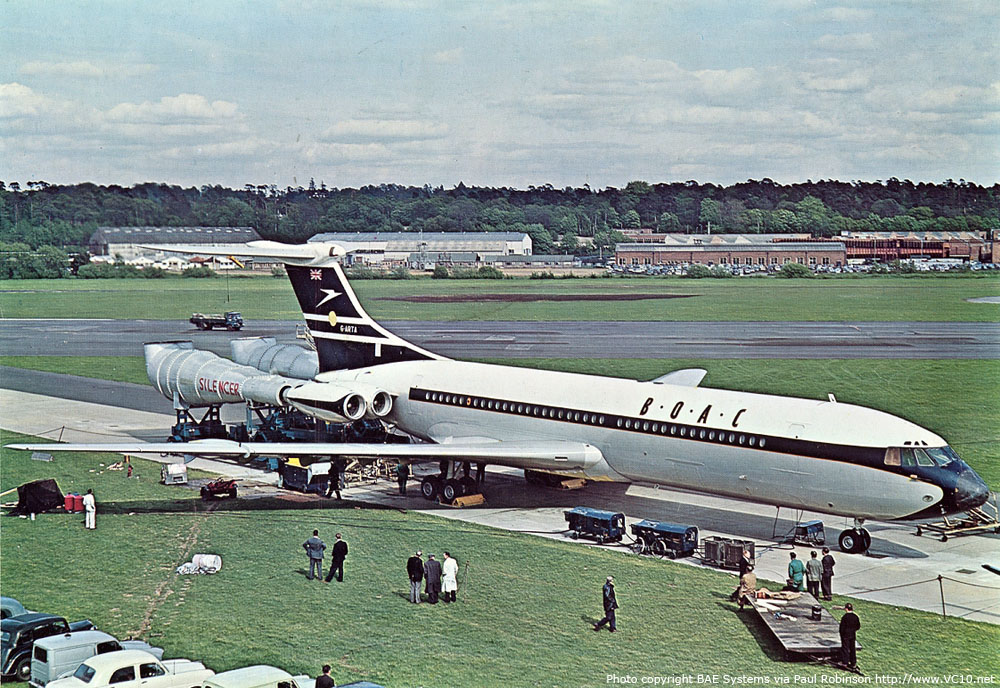
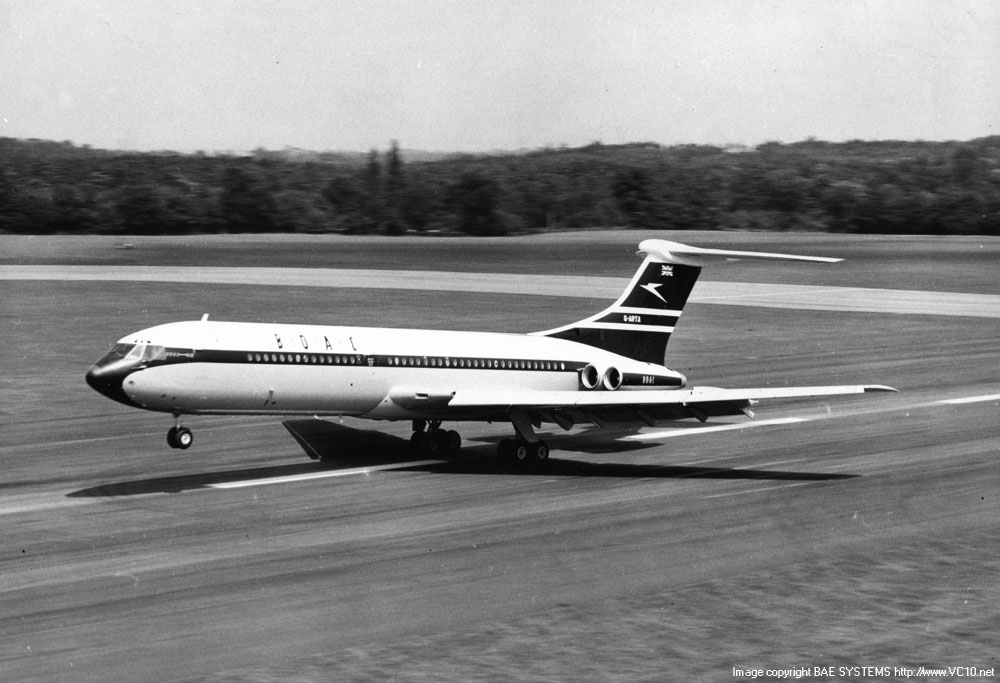
G-ARTA cruising over the English countryside during early testing Photo copyright BAE SYSTEMS Construction number 803 was allocated to the first airframe on the VC10 production line that would actually take to the air. It was also the first airframe that would be completely fitted out, as previous airframes were meant for static tests only. On 15 April 1962 the completed aircraft was rolled out of the factory and two months later, on 29 June 1962 it took to the air for the first time. This first flight was surrounded by some uncertanties as the 1260 yard (1152m) runway at Brooklands was originally deemed to be too short for the VC10. The aerodynamics department did some calculating and decided on an 'unstick' distance of 550 yards (502 m). By extending the runway by 200 yards (183m) at the North end, which was slightly misaligned and therefore meant making a turn at 30 knots, a lightly loaded VC10 should be able to take off. To be on the safe side a big yellow line - about 20ft (6m) thick - across the runway warned the pilot of the dimishing room left if he would decide to abandon the take off. If this were to happen the aircraft would need all of the 1460 yards (1335m) available to stop before ending up in the grass. In the end the calculations worked out and with plenty of room to spare G-ARTA lifted off late in the afternoon for a very short flight to Wisley, BAC's flight test center just a few miles away, for further fitting out and the start of an extensive series of tests.
G-ARTA would remain the single
prototype, but later on was joined by other aircraft which were built to
production standard for BOAC but were used for development work as well. During
flight testing some problems surfaced that had not been foreseen, the most
important one being a significantly higher cruise drag number. To rectify this
G-ARTA flew a lot of sorties, including a few from the long runway at Boscombe
Down with all the flaps and slats taped over in the closed position, to ascertain
whether this would lead to an improvement in drag number. This of course meant a
take off and landing without flaps or slats, which explains the use of Boscombe
Down's runway. Later on tufts of fibre were attached to the airframe and it
was photographed in flight from a Canberra at different speeds and altitudes to find
any flow problems. One of these problems turned out to be a tremendous amount of
backflow that existed at the back of the engine nacelle in between the two
exhausts. This led to a modification to the engine nacelle that filled up the
area between the exhausts with the so-called 'beaver tail'.
G-ARTA flew the entire pilot's flying manual and, in doing so, created that manual for this aircraft. Best climb rates, different engine settings, approach profiles, the stall regime and much more were all part of the VC10's development programme. Over 2000 stall profiles were flown with G-ARTA to validate the low-speed regime. The aircraft would remain in its development role for several years. Official deliveries to BOAC and BUA had started in 1964, but it wasn't until the end of 1967 that G-ARTA was flown back to Weybridge to be converted to airline standard as a Type 1109, the only one of its kind. In this guise it was sold to Freddie Laker, who bought it as an investment and immediately leased the aircraft to Middle East Airways as OD-AFA. It flew with MEA for just over a year and on the end of its lease Freddie Laker sold it on to his old employers BUA. After the merger it reemerged in British Caledonian colors named 'Loch Ness'. It flew on with BCal for three years until a particular arrival at Gatwick put a dent in both her career and her fuselage. That particular day G-ARTA ended up at Heathrow as its base Gatwick was fogged in. When the fog lifted a short ferry flight was scheduled, and as he lived near Gatwick a BCal employee who had never flown before was invited to go along on the jumpseat. All went well throughout the flight until on final approach the co-pilot misinterpreted a command from the captain and, with the main gear still several feet above the runway, pulled the spoiler/speedbrake handle completely back. This completely spoiled the lift over the wing (as spoilers are supposed to do) and instead of making a smooth touchdown as VC10s normally do, the aircraft just fell the last few feet to earth. Even though a VC10 main gear is designed to
withstand a fairly heavy landing, this could with all fairness only be described as an arrival, or even a controlled collision between the VC10 and planet earth. While the flight crew were still wondering what went wrong the passenger on the jumpseat was counting the fillings in his teeth and asked the captain "Is it always like this?" to which the blunt reply was heard: "No it bloody well isn't. Shut up!" The extent of the damage done by this small error did not come to light until the aircraft was parked and they got a chance to inspect the outside of the aircraft. The sleek profile of the VC10 was marred by several deep creases in the fuselage undersurfaces just forward of the wing leading edge. After this the aircraft was
parked in a corner of the airfield awaiting a decision on whether it would
be economical to straighten her out, but in the end it was decided that
this was not the case. The once proud prototype VC10 was broken up and
scrapped where she stood. And so a small error on 28 January 1972 put an
end to the career of this important aircraft. More info The first flight as seen from the left seat Timeline
More images
1. Rollout of G-ARTA at Weybridge on 15th April 1962.
1&2. G-ARTA parked at Weybridge before her first flight.
1. The first take off as seen from further along the runway. Of interest is that the photo editor has done a lot of retouching on this photo, adding contrast to almost every line on the aircraft and some persons in front of the prototype.
1. A nice topside pass, place and time unknown unfortunately. The spoiler panels have not been modified yet so this was during the early days of testing.
1. The VC10 prototype was still being flown for testing purposes by this
time but painted in BOAC colours. In the end BOAC never operated this airframe.
1. As this photo shows, the wing appears to have been rebuilt to 1103 specs with extended leading edge and cambered wingtips.
1-2. G-ARTA in British Caledonian colourscheme taking off and climbing away from an unknown location.
Colourschemes
|