|
Home
Up
C/n 801/2 - Test Specimen
C/n 803 - G-ARTA
C/n 804 - G-ARVA - 5N-ABD
C/n 805 - G-ARVB
C/n 806 - G-ARVC - ZA144
C/n 807 - G-ARVE
C/n 808 - G-ARVF
C/n 809 - G-ARVG - ZA141
C/n 810 - G-ARVH
C/n 811 - G-ARVI - ZA142
C/n 812 - G-ARVJ - ZD493
C/n 813 - G-ARVK - ZA143
C/n 814 - G-ARVL - ZA140
C/n 815 - G-ARVM
C/n 819 - G-ASIW - 7Q-YKH
C/n 820 - G-ASIX - A4O-AB
C/n 823 - 9G-ABO
C/n 824 - 9G-ABP
C/n 825 - G-ATDJ - XX914
C/n 826 - XR806
C/n 827 - XR807
C/n 828 - XR808
C/n 829 - XR809
C/n 830 - XR810
C/n 831 - XV101
C/n 832 - XV102
C/n 833 - XV103
C/n 834 - XV104
C/n 835 - XV105
C/n 836 - XV106
C/n 837 - XV107
C/n 838 - XV108
C/n 839 - XV109
C/n 851 - G-ASGA - ZD230
C/n 852 - G-ASGB
C/n 853 - G-ASGC
C/n 854 - G-ASGD
C/n 855 - G-ASGE
C/n 856 - G-ASGF
C/n 857 - G-ASGG - ZD235
C/n 858 - G-ASGH
C/n 859 - G-ASGI
C/n 860 - G-ASGJ
C/n 861 - G-ASGK
C/n 862 - G-ASGL - ZD240
C/n 863 - G-ASGM - ZD241
C/n 864 - G-ASGN
C/n 865 - G-ASGO
C/n 866 - G-ASGP - ZD242
C/n 867 - G-ASGR
C/n 881 - 5X-UVA
C/n 882 - 5H-MMT - ZA147
C/n 883 - 5Y-ADA - ZA148
C/n 884 - 5X-UVJ - ZA149
C/n 885 - 5H-MOG - ZA150
Send E-mail
Note: Remove the last section from the e-mail address before
sending!

View My Guestbook
Sign My Guestbook
| |
C/n 820 - G-ASIX - A4O-AB

A4O-AB pictured
at Brooklands in 1998
Picture
by J. Hieminga
VC10 construction number 820 first flew from Weybridge on 17
October 1964 as G-ASIX. The plane was built as a Type 1103 for Freddie Laker's
British United Airways. The Type 1103 incorporated several 'upgrades'
compared to BOAC's 1101s, some of which are: a 4% wing chord extension on
the inboard section to improve the cruise drag, a large cargo door in the
forward fuselage side, downturned 'Kuchemann' wingtips which helped to
cure an instability in the stall. It flew with BUA for several years
(during which it was involved in the Andes incident described here)
alongside it's sister ships
G-ASIW and G-ATDJ until in 1970 BUA merged
with Caledonian Airways to become British Caledonian. In their new colors
the VC10s flew on, joined by the VC10 prototype which had been converted
to airline standard in 1969. As BCal had already ordered 707s the VC10's
days were numbered and in 1974 they were sold off with G-ASIX going to the
Omani Government for the Sultan's Royal Flight.
This change of ownership initiated its second career, but
not before some redecoration took place inside the aircraft. The Sultan of
Oman appreciating some level of comfort on his personal transport, after a
registration change to A4O-AB (fitting in nicely with the Sultan's
Gulfstream G-II: A4O-AA), the aircraft was moved to Hurn to
be suitably converted and decorated. This saw the aircraft emerge as a
very luxurious transport indeed, with a lounge incorporating two large
swivel chairs, a comfortable couch and tables, two bedrooms, an extremely large galley and a section for staff members seating 32
which may just have been a bit more comfortable than a business class seat
is today.

G-ASIX with the short-lived Caledonian/BUA titles which were applied just after the merger
Photo British Caledonian via J. Downey

G-ASIX seen in British Caledonian livery at Las
Palmas in 1972
Photo via Aviation Photography of Miami collection

Shortly
after conversion for the Sultan, still in BCal colors (1974)
Photo
by Paul Robinson |
After the conversion at Hurn the aircraft was repainted in a quite attractive white livery with a red
and green cheatline. For the next 13 years the aircraft would be a regular
visitor to the United Kingdom for visits, maintenance at Dan-Air's
facilities at Lasham as well as many other purposes. In 1982 the aircraft went to Basle where the interior got an upgrade which created the two bedrooms with twin beds and some other changes. The story goes that
the VC10 would occasionally be sent to the UK when someone in the Sultan's
household would get a craving for fresh strawberries, the crew doing a
quick round-trip flying an otherwise empty aircraft back with a few trays
of strawberries on board. Another popular story involved one member of the Sultan's
crew, known as the 'flying spanner' to his colleagues. Although trained as
a Ground Engineer, he travelled on board the aircraft and was responsible
for sorting out any snags that might occur whilst in flight or on the
ground. One of the Sultan's favourite destinations in the VC10 was India
where he would go with a retinue of hawks and their handlers. They
travelled in the passenger cabin which would usually leave some tell-tale traces on the floor. As it was
the engineer's job to keep the aircraft looking pretty, after these
regular outings his job may just have been a bit less attractive than on
other days. Not knowing the usual wages Sultans pay, we can of course only
guess at his salary except to say that it must have been sufficient.

Pictured at Lasham in 1985

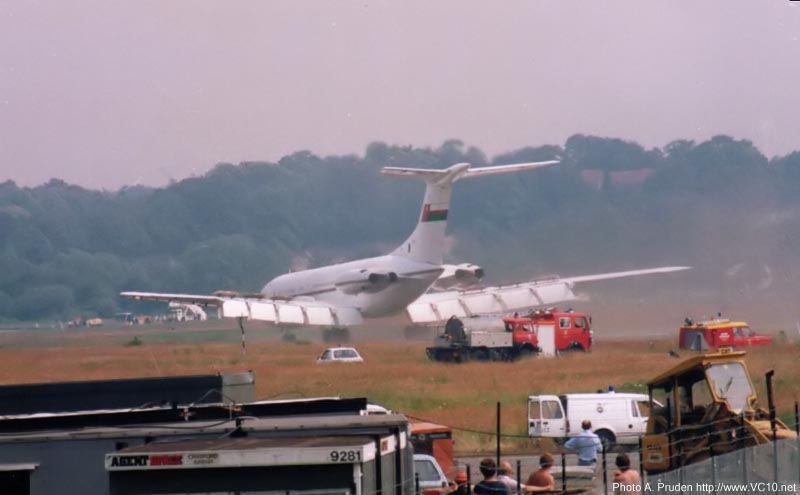
A4O-AB landing at Brooklands
after her last flight on 6th July 1987
Photo by A.
Pruden
|
After enjoying the use of his VC10 for 13 years the Sultan felt it was
time for something different. As it held sentimental value the Sultan decided that the aircraft should be
preserved somewhere. The by then newly established Brooklands Museum was
interested, and in the end a deal was struck in which the VC10 would
return to its birthplace to remain there as a tribute to all the VC10s
that were built at the site. One slight problem remained though: although
every VC10 built was flown out from Weybridge, flying one back was
something on which little experience was available. It is known that the
prototype went back to be converted to airline standard, and there is a
picture in existence of a BOAC Standard (G-ARVK) on a very low approach to the
Weybridge runway but there the available information ended (although Brian
Trubshaw remarks in his book 'Test Pilot': "The return of both VC10s and
BAC 1-11s into Brooklands became a regular event"). At least
everyone agreed that it could be done, and even though the runway hadn't
been used for a while all of it was still there, and all was done to
facilitate the crew of the Sultan's aircraft.
This involved pulling down
some trees and lamp-poles on the road beyond the approach end, flying the crew in a
helicopter down the approach so they could hover there to study the view
they would have from the aircraft, but also going round Byfleet to explain
to the citizens that there would be an aircraft flying low over their neighborhood
and that this should not pose any danger, all was under control. Many
questions were asked by the insurance company: would there be a fire crew available? Yes, they
would be there. Would there be police to control the crowd? Yes again, and
for the same reason as the fire crew: they wanted to see this event with
their own eyes! And so it happened that on 6th July 1987 the VC10 flew
its last ever flight from Heathrow to Brooklands, first performing a
fly-by and after this touching down smoothly on the same runway it left 23
years before. It met with a tremendous reception, with Sir George Edwards
amongst the invited guests, and to this day the aircraft is still
appreciated at this historic site.
To read more about the arrival of A4O-AB, as seen from the flightdeck by Captain Richard King, see here: The first and last VC10 flight of Captain Richard King.
In 1991 a request was received to remove the registration A4O-AB
from the airframe. Up until that point the aircraft was still registered in
Oman, but the Sultan wanted to be able to use the markings on a new aircraft and
so in December 1991 the registration was painted over on the VC10. It was reapplied in July 2023 during an exterior renovation.
From 1998 on the
Brooklands Museum Summer Project made it possible to get a lot of restoration
work done on the outside of the aircraft. For more info on the project have a
look here. Since then the VC10
has also had some worse days, as in 1999 a large crack was discovered in the
left main undercarriage which needed repairing. To add a further indignity, the
fall of 2000 saw the river Wey burst its banks and this left the VC10 in a large
pool of water as can be seen from the photo below. Fortunately the undercarriage
was repaired in 2002, for the full story visit this
page. In 2004 developments at the museum meant that the Vanguard and VC10 had to be moved inside the museum grounds, this page shows how they crossed the river Wey.
For
the curious: What does a Sultan buy after donating a VC10? A Boeing 747SP of
course, have a look here for an impression.
Small note: In December 2006 a visitor pointed out that the official prefix for
Omani registrations is A4O- and not A40- as I had been using. The difference is
in the letter 'O' instead of the number zero. All the registrations listed here
should now be correct as set out in ICAO Annex 7.
More Info
The first and last VC10 flight of Captain Richard King
Brooklands Museum
Summer Project
The Old
Lady needs a Hip Replacement
Transport - Sultan Style
Moving Aircraft at
Brooklands
Flight plan and E/O log
Timeline
| Date |
|
| 31 May 1961 |
BUA announces order for four VC10s, contract signed on 3 January 1962 for two aircraft with an option on two more. |
| 29 May 1963 |
Registered as G-ASIX to British United Airways. |
| 17 October 1964 |
First flight from Brooklands to Wisley, captained by Lew Roberts. |
| 30 October 1964 |
Certificate of airworthiness issued to BUA (ARB ref. A7930). |
| 31 October 1964 |
Delivery to BUA as G-ASIX. |
| 2 November 1964 |
Ferried from Wisley to London Gatwick. |
| 5 July 1965 |
Ferried back to Brooklands from Gatwick, flown by Eddie McNamara and Eric Bucklow, for unknown modifications. |
| September 1965 |
Left Brooklands again after completion of modifications. |
| June 1966 |
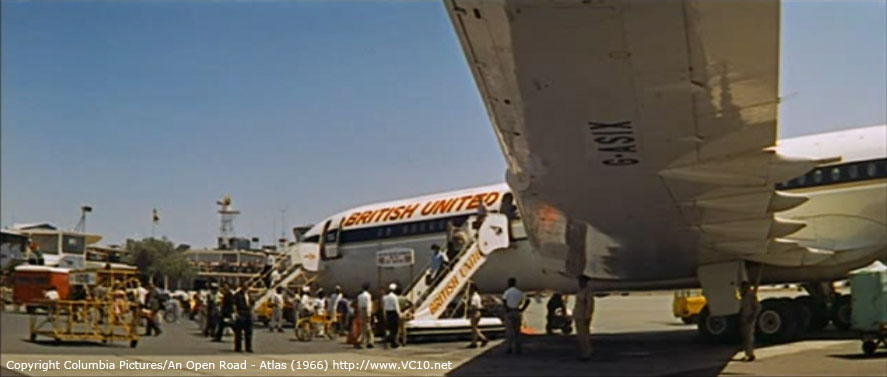
Features in the movie 'Born Free'. |
| 11 August 1966 |
Carries out the first service in the new Blue-Sandstone livery, from London to South-America. |
| 11 September 1966 |
Participates in Farnborough Air Show, both in the static and flying displays. |
| 25 September 1966 |
Carried the Duke of Edinburgh to Buenos Aires via Rio, in a special Royal compartment at the rear of the First Class section. This was scheduled service BR663, departing at 21:05. The Duke returned on another scheduled flight on 17th October. |
| 30 November 1970 |
Ownership changed to Caledonian-British United Airways due to merger. |
| 22 February 1971 |
Operated London to Nairobi, was fitted with a 'Jet-Sec' office between first and economy class. |
| 1 March 1971 |
First Caledonian/BUA VC10 to be repainted in the 'Golden Lion' scheme. Named 'Loch Maree'. |
| 18 June 1971 |
Sustained substantial damage in Andes incident. |
| 1 September 1971 |
Caledonian-British United Airways renamed to British Caledonian Airways, fuselage titles soon changed to reflect this. |
| 28 February 1973 |
Operated Nairobi - Entebbe - London. |
| 21 August 1973 |
Operated London - Entebbe - Nairobi. |
| 2 September 1973 |
Operated Nairobi - London Gatwick. |
| 2 October 1974 |
Aircraft sold to Sultan Qaboos bin Said al Said of Oman for use in the Royal Flight. |
| 10 October 1974 |
Re-registered as A4O-AB. |
| 11 October 1974 |
Rolled out at London Gatwick with new registration. |
| 15 October 1974 |
Delivered to Bournemouth Hurn. |
| 23 October 1974 |
Seen at London Stansted during a crew training sortie. |
| 9 November 1974 |
Noted taxiing at Bournemouth Hurn in basic BCal livery minus titles and with plain dark-blue fin with registration. First VIP interior fitted at BAC Hurn. |
| 1975 |
Repainted in first Royal flight livery at BAC Filton. |
| 22 September 1975 |
Visit to London Heathrow in new livery. |
| 1982 |
Interior changed to second VIP version at Jet Aviation Basle. |
| 5 July 1987 |
Left Seeb, Oman for the last time, flown to London Heathrow. |
| 6 July 1987 |
Carried out last ever flight of a civil VC10. Flown from London Heathrow, via a flypast at Farnborough, to Brooklands where the runway was reopened for this occasion. Preserved at Brooklands Museum, having been donated to the museum by the Sultan of Oman. |
| |
|
| December 1991 |
Registration on the aircraft painted over as the Sultan wanted to re-use it on a new Gulfstream. |
| September 1999 |
Left undercarriage damaged when an old stress crack caused a fracture of the main trunnion. |
| 14-16 June 2002 |
A team of volunteers from RAF St. Athan repairs the damaged undercarriage, replacing the main trunnion. |
| 7 June 2004 |
The VC10 was moved across the river Wey into the main aircraft park of the Museum. |
| July 2023 |
Registration A4O-AB re-applied during exterior makeover. See this page for more about the other user. |
More Images

Photo copyright BAE Systems / Brookands Museum archives |

Photo copyright BAE Systems / collection J. Hieminga |

Copyright Flightpath Postcards / Carl McQuaide |

Copyright Columbia Pictures / An Open Road - Atlas (1966) |
1. The first take off from Brooklands was an enthusiastic one.
2. Judging by the date, this must be G-ASIX parked on the compass base at Wisley. The airframe appears to have an underwing fence that, I thought, was only tested on G-ASIW and 9G-ABO.
3. The last two letters of the registration are marked on the nose in white, which must have helped to keep these airframes apart.
4. In 1966 the movie 'Born Free' was released in which G-ASIX plays a small part. In this shot a BUA VC10 can be seen, this may be 'IX. A dynamic take off shot of a BUA VC10 followes this scene.

Copyright Columbia Pictures / An Open Road - Atlas (1966) |

Copyright Columbia Pictures / An Open Road - Atlas (1966) |

Photo collection J. Hieminga |

Photo collection J. Hieminga |
1. Later on during the movie the airframe used can be clearly identified from the registration under the wing.
2. Actress Virginia McKenna can be seen here (with white bag) descending the steps from G-ASIX.
3. G-ASIX was the first BUA VC10 to be repainted in the new 'blue & sandstone' scheme in the Gatwick hangar.
4. Parked on the apron with engine covers on.

Photo collection J. Hieminga |

Photo BUA/Vickers via H. de Ridder |

Photo BUA/Vickers via H. de Ridder |

Photo collection J. Hieminga |
1. G-ASIX parked, seen in the second BUA scheme of a
blue/sandstone cheatline over white.
2. A dynamic promotion shot of G-ASIX taken in 1967.
3. A photo of G-ASIX taken at Nairobi during her career as an airliner.
Obviously cargo was also being loaded on the maindeck through the large
cargo door.
4. Undergoing maintenance at Gatwick in 1969.

Photo collection J. Hieminga |

Photo W. Wedrychowski |

Photo W. Wedrychowski |

Photo W. Wedrychowski |
1. A4O-AB still in British Caledionian colors, seen at Gatwick.
2. At its new base: parked in front of the Royal Flight reception building.
3.
The VC10 parked next to another Royal Flight aircraft: a
Gulfstream G-II registered as A4O-AA.
4. Operating a flight on the Sultan's VC10.
1. Parked in front of TBC at Heathrow's maintenance base next to G-ASGM and G-ASGL.
2. Parked next to G-ARVJ, which was used as a private VC10 for the Emir of Qatar, in July 1977.
3. A4O-AB on approach to land at Zurich-Kloten Airport on 15 February 1981.
4. This photo taken in 1985 shows the difference with the green
stripe on the tail removed and a slightly larger flag instead.

Photo A. Pruden |

Photo A. Pruden |

Photo A. Pruden |

Photo
J. Hieminga |
1. Arrival at Brooklands: the aircraft first performed a flypast
with gear and flaps still up.
2. Then turned around and passed once more with gear and flaps down.
3. As can be seen from this shot the fire crew was also present. The aircraft is
coming to a stop with flaps fully down and spoilers extended.
4.
A4O-AB seen at Brooklands in 1999.

Photo
J. Hieminga |

Photo Brooklands Museum |

Photo
J. Hieminga |

Photo
J. Hieminga |
1. Another photo of A4O-AB taken at Brooklands in 1999.
2. In the fall
of 2000 large areas of Southern England flooded after extremely heavy
rains and the river Wey also burst its banks, leaving A4O-AB in this
sorry situation. Unfortunately the museum also suffered extensive damage
to the clubhouse and other buildings.
3&4.
The
back end of a VC10.

Photo
J. Hieminga |

Photo
J. Hieminga |

Photo
J. Hieminga |

Photo
J. Hieminga |
1. It
is quite difficult to get the complete aircraft in one shot from this angle. The
first try consisted of five photos taped together, this one uses three.
2. The
flight deck of A4O-AB. In the center are the two Inertial Navigation Systems
that were put in during its time with the Sultan of Oman Royal Flight.
3. The
flight engineer's station.
4. The
Sultan's lounge, looking aft. As you leave the lounge going aft the two
bedrooms are on the left side and the rear entrance door is opposite them.

Photo
J. Hieminga
|

Photo
J. Hieminga
|

Photo
J. Hieminga
|

Photo
T. Singfield |
1. Two bedrooms, the rear one being shown here, are situated on
the right-hand side, behind the forward lounge. Both bedrooms have twin beds
with safety belts!
2. The
interior in the aft cabin, seating 32 in comfort. For years some ex-RAF tables were fitted in this area as it could then be used for functions, these were recently removed to restore the area to how it looked in the Sultan's service.
3. Behind the aft cabin is the rear galley, a rather spacious affair with
ample storage space and room to work, the port side is shown here.
4. In 2023 the registration was reapplied as part of an exterior refurbishment. This had been removed in 1991.
Colourschemes
| BUA |
Dark blue and red over white with large Union Jack
on fin. |
| BUA |
Blue and sandstone scheme, white over grey fuselage with large
blue/sandstone cheatline sweeping up over the fin. Text on engine
nacelles was later removed to match the 1-11 scheme. |
| BCal |
Initially titled as 'Caledonian//BUA', white over
grey fuselage with dark blue and gold cheatline, dark blue fin with
lion rampant. Known as 'Golden Lion' scheme. Titles later changed to
'British Caledonian'. All aircraft were named after Scottish lochs. |
| Sultan of Oman |
Variation on BCal scheme, titling removed and fin painted all over dark-blue. White registration on fin. |
| Sultan of Oman |
All over white scheme with green over red cheatline. Green line curving up the fin and Omani flag on fin. |
| Sultan of Oman |
Same as earlier scheme but without curving green line and with larger Omani flag on the fin.
Note: apparently the cheatline should have been reversed, with red on top, to conform to the colours of the Omani flag. Other Omani Royal Flight aircraft have carried this same scheme but in later years the cheatline was changed. |
Back to top |